


Gas vs Electric Tankless Water Heater: Which One Is Right for Your Southern California Home?
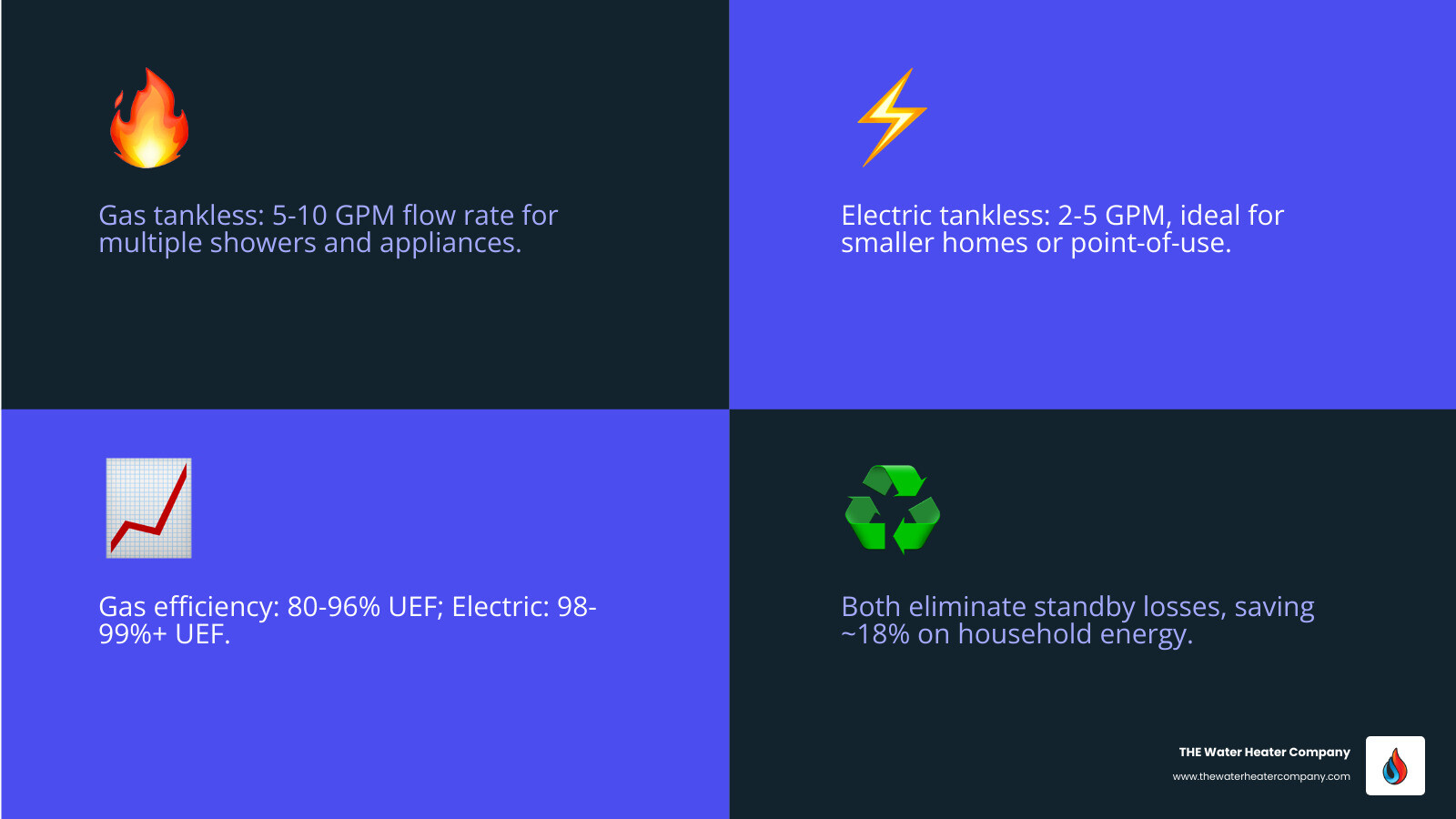
A gas vs electric tankless water heater comparison comes down to a few key differences that matter most for Southern California homeowners: flow rate, efficiency, and what your home is already set up for.
| Factor | Gas Tankless | Electric Tankless |
|---|---|---|
| Flow Rate | 5-10 GPM (up to 12 GPM) | 2-5 GPM (up to 8 GPM in warm climates) |
| Energy Efficiency | 80-96% UEF | 98-99%+ UEF |
| Best For | Large households, high demand | Smaller homes, point-of-use |
| Installation Complexity | Higher (venting + gas line) | Lower (electrical upgrade may be needed) |
| Cold Climate Performance | Excellent | Limited at high demand |
| Emissions | Combustion gases (venting required) | Zero on-site emissions |
| Lifespan | 15-20+ years | 15-20+ years |
Heating water accounts for roughly 18% of your household’s energy use — so the choice between gas and electric isn’t just about hot showers. It affects your monthly bills, your home’s infrastructure, and how well your system holds up during a busy morning when the dishwasher, laundry, and two showers are all running at once. Both types eliminate the standby energy losses of traditional tank water heaters, but they handle demand, efficiency, and installation very differently. This guide breaks down exactly where they differ so you can make a confident decision for your home.
I’m Anthony Hamilton, Co-Founder and CEO of THE Water Heater Company, and with years of hands-on experience helping Southern California homeowners navigate a gas vs electric tankless water heater comparison, I’ve seen how the right choice depends on your specific home setup and daily hot water demands. Let’s walk through everything you need to know.
How Gas and Electric Tankless Systems Generate Hot Water
To understand which system fits your home in Pasadena or Irvine, we first need to look at the “magic” happening inside the box. Unlike traditional tanks that keep 40 to 50 gallons of water hot all day long (wasting energy in the process), tankless units only spring into action when you turn on a tap.
In a gas tankless water heater, a sensor detects water flow and ignites a powerful combustion burner. This burner heats a component called a heat exchanger. As cold water travels through the exchanger’s coils, it picks up intense heat instantly before heading to your shower. Because gas can generate a massive amount of heat very quickly, these units are known for their high performance.
Electric tankless water heaters work similarly but swap the fire for electrical resistance elements—think of the coils in a toaster, but much more powerful and submerged in water. When you call for hot water, these elements glow white-hot, transferring energy directly to the water.
Both systems are incredible space-savers and eliminate “standby loss,” which is the energy wasted by a tank sitting idle. If you want to dive deeper into the mechanics of these systems, check out more info about tankless water heaters.
Gas vs Electric Tankless Water Heater Comparison: Performance and Flow Rates

When we talk about performance, we are really talking about Gallons Per Minute (GPM). This is the measure of how much hot water a unit can produce at a specific temperature. In Southern California, our groundwater is generally warmer than in the Midwest, which gives both gas and electric units a “head start.” However, the performance gap between the two is still significant.
Flow Rate Differences in a Gas vs Electric Tankless Water Heater Comparison
Gas tankless water heaters are the heavyweights of the industry. They typically deliver between 5 and 10 GPM, with some high-end condensing models reaching up to 12 GPM. To put that in perspective, a standard shower uses about 2 GPM. A gas unit can easily handle two showers, a dishwasher, and a load of laundry all at once.
Electric tankless units generally range from 2 to 5 GPM. While they can reach up to 8 GPM in very warm climates, they often struggle to keep up with multiple high-demand fixtures simultaneously. If you live in a smaller condo in Van Nuys with one bathroom, an electric unit might be perfect. But for a large family home in Santa Clarita, gas is often the more reliable choice for consistent pressure.
| Fixture Type | Average GPM | Gas Capacity | Electric Capacity |
|---|---|---|---|
| Low-Flow Shower | 1.5 – 2.0 | 3-5 Fixtures | 1-2 Fixtures |
| Kitchen Faucet | 1.0 – 2.2 | 4-6 Fixtures | 2-3 Fixtures |
| Washing Machine | 2.0 – 3.0 | 2-3 Fixtures | 1 Fixture |
If your current water heater is struggling to keep up with your family’s needs, it might be time for an upgrade. You can find more info about water heater replacement to see how a tankless system can change your daily routine.
Climate Suitability in a Gas vs Electric Tankless Water Heater Comparison
Climate plays a massive role in how these heaters perform. Even in sunny Los Angeles or Santa Barbara, winter groundwater temperatures can drop. When the incoming water is colder, the heater has to work much harder to reach your desired output (usually 120°F).
Gas units excel in these “high-temperature rise” scenarios. They can ramp up their BTU (British Thermal Unit) output almost instantly to compensate for cold winter water. Electric units, however, have a hard ceiling on how much power they can draw from your home’s electrical panel. In the middle of a chilly Santa Barbara January, an electric unit that provides 5 GPM in the summer might drop to 3 GPM, potentially leaving you with a lukewarm shower if the dishwasher is running.
Efficiency and Environmental Impact for Southern California Homes
In April 2026, efficiency is more than just a buzzword—it’s a requirement for many Southern California residents looking to reduce their carbon footprint.
Electric tankless water heaters are the champions of thermal efficiency, often rated at 98% to 99%+. This means almost every bit of electricity you pay for goes directly into the water. They also produce zero on-site emissions, making them a “green” choice, especially if your home uses solar panels.
Gas tankless water heaters have Uniform Energy Factor (UEF) ratings between 0.81 and 0.96. While they are slightly less efficient than electric models due to heat lost through venting, they are still vastly superior to old-fashioned tank heaters. Condensing gas models are the most efficient in this category, as they use a secondary heat exchanger to capture heat from exhaust gases that would otherwise be wasted.
Beyond the heater itself, the quality of the water flowing through it matters. Hard water can scale up a tankless unit quickly. We recommend looking into more info about water filtration and conditioning to protect your investment.
Energy Efficiency in a Gas vs Electric Tankless Water Heater Comparison
While electric units are more efficient at the point of use, the “best” choice for your wallet depends on local utility rates. Historically, natural gas has been cheaper to operate than electricity in many parts of Southern California, though electricity prices have shown more stability over long periods compared to the volatility of gas.
One thing is certain: switching to any tankless model can save a significant amount of energy. Since water heating accounts for roughly 18% of a home’s energy use, moving away from a tank that heats water 24/7 is a major win for your utility bill.
Infrastructure Requirements and Long-Term Maintenance
Before you fall in love with a specific model, we have to look at your home’s “bones.” The gas vs electric tankless water heater comparison often ends right here based on what your house can actually support.
Infrastructure Needs
- Electric Units: These require a massive amount of power. Most whole-home electric tankless units need a 200-amp or even a 300-amp electrical service. If your older home in Pasadena still has a 100-amp panel, you’ll need a significant electrical upgrade before you can go tankless.
- Gas Units: These require specialized venting to safely move combustion gases out of your home. They also need a gas line that is large enough to supply the high BTU demand of the unit. If you are replacing a tank heater, your existing gas line may need to be upsized.
If you ever run into issues with your existing setup, our team is ready to help. You can find more info about water heater repair to keep your system running smoothly.
Maintenance Needs for a Gas vs Electric Tankless Water Heater Comparison
Both types of heaters can last 15 to 20 years—double the lifespan of a traditional tank—but only if they are maintained.
Southern California is known for hard water. Over time, calcium and magnesium can build up inside the narrow passages of a tankless heat exchanger. This “scaling” acts like insulation, forcing the unit to work harder and eventually leading to failure. We recommend an annual flush and descaling for all tankless units.
Gas units require a bit more attention because they involve combustion. A professional should inspect the burners and the venting system annually to ensure there are no blockages or safety hazards. In cities like Santa Clarita and Pasadena, where water mineral content can be high, staying on top of this maintenance is the difference between a system that lasts 20 years and one that fails in seven.
Frequently Asked Questions
Which type is better for large households in Southern California?
For most large households in our service areas—from Camarillo to Irvine—gas tankless water heaters are the superior choice. The high GPM flow rates (5-10+) allow for simultaneous hot water use in multiple bathrooms without a drop in temperature or pressure. If you have a family of four or more, gas provides the “endless” experience people expect from tankless technology.
Do tankless water heaters work during a power outage?
This is a common myth! Many people assume gas heaters will work during a blackout because they use gas. However, modern gas tankless heaters use electronic ignitions and digital control boards that require electricity. Unless you have a battery backup or a generator, neither a gas nor an electric tankless unit will provide hot water during a power outage.
How long do gas and electric tankless units last?
With proper professional maintenance, both types are designed to last 15 to 20 years or more. This is a significant upgrade over traditional tank heaters, which typically last only 6 to 10 years. Because tankless units don’t hold water, they aren’t prone to the same rust and corrosion issues that eventually cause tanks to leak and flood.
Conclusion
Choosing between a gas and electric tankless water heater is a big decision, but you don’t have to make it alone. Whether you are looking for the raw power and high flow rates of a gas system or the sleek, vent-free efficiency of an electric model, the right choice depends on your home’s infrastructure and your family’s lifestyle.
At THE Water Heater Company, we pride ourselves on being the local experts for Southern California. We serve Santa Barbara, Camarillo, Santa Clarita, Pasadena, Van Nuys, Los Angeles, Santa Ana, and Irvine with a commitment to quality and transparency. Our family-owned business is dedicated to ensuring you never have to worry about a cold shower again.
Ready to make the switch or need a professional opinion on your current system? We often have special offers to help our neighbors get the best value. Check out more info about our specials and rebates and give us a call today. We look forward to helping you find the perfect hot water solution for your home!

The Essential’s
Call THE Water Heater Company today to get immediate help with your water needs.
“
-

“Fair Pricing & Expert Service”
Their technician Gonzo, was clearly very competent and more importantly, he took the time and effort to do a really fantastic job.
-
“Fantastic Service!”
THE Water Heater Company understood the situation I was going through. They were able to help me out and get the job done quickly.
-
“Reasonable Pricing”
Kevin did a great job on replacing my old leaky yet still working water heater. He answered all my questions and explained all the details. -
“Quick Response Time”
He was very informative and responsive to my questions and when I am making a huge investment in my home I want to be sure I am going with a company I could count on and would not cut corners. -
“Real Professionals”
Communication was great with the owner and they were very responsive, ensuring a first-class installation and experience.
-
“Great Service”
Not only did he do the service we needed, but checked the whole unit in addition to other waterline components. -
“Professional and Responsive”
They have repaired my water heater, installed a hot water recirculating pump, and now installed a new water heater. -
“Real Professionals”
It took a little over three hours but no management was necessary as the guys were very competent and clearly have been doing this for a long time.


