


Why Understanding Tankless Water Heater Benefits and How They Work Can Transform Your Home’s Hot Water
Tankless water heater benefits and how they work is something every Southern California homeowner should understand before making a decision about their home’s hot water system. The core idea is simple: instead of keeping a large tank of hot water on standby 24/7, a tankless unit heats water instantly, only when you need it. No storage, no standby energy waste, no running out mid-shower.
Here’s a quick snapshot of what you need to know:
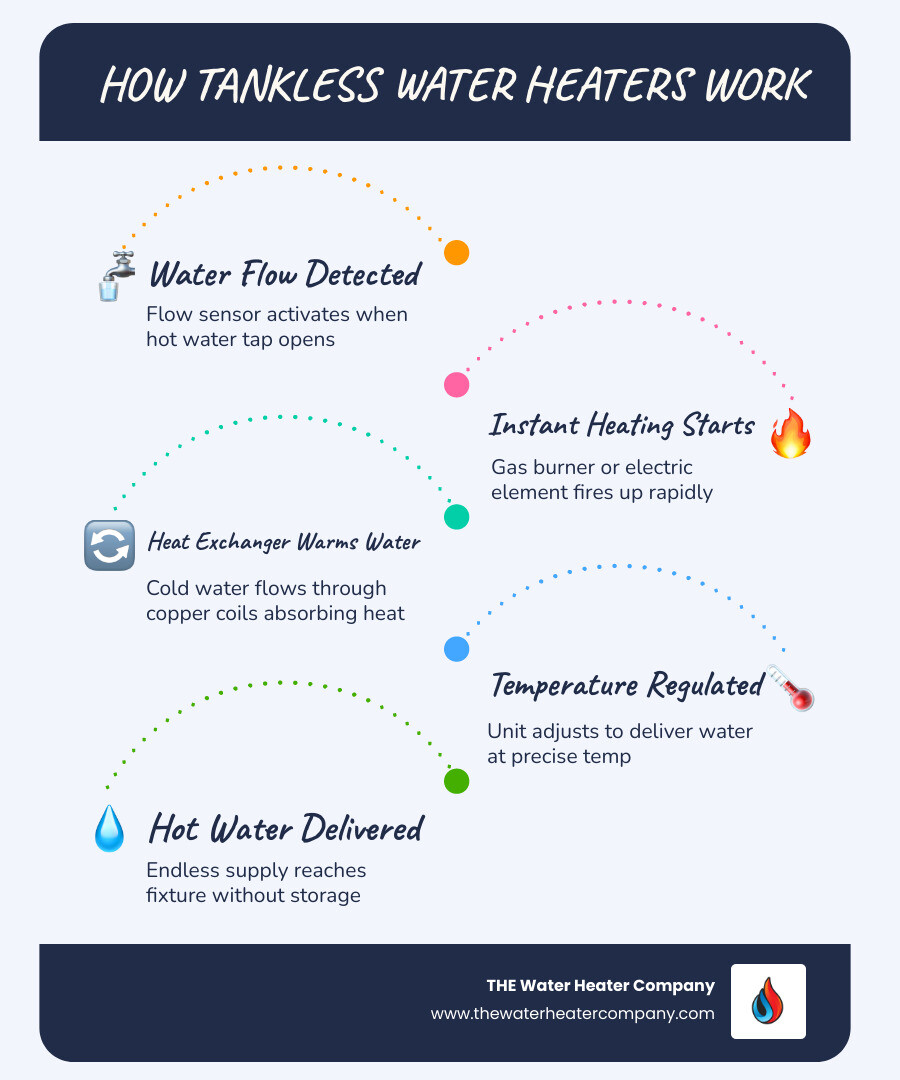
- How it works: When you turn on a hot water tap, cold water flows through the unit and is heated instantly by a gas burner or electric element — then delivered directly to your fixture.
- Energy efficiency: According to the U.S. Department of Energy, tankless heaters can be 24–34% more energy efficient than traditional tank models for homes using 41 gallons or less of hot water per day.
- Endless hot water: Because water is heated on demand, you won’t run out — even with multiple people in the house.
- Longer lifespan: Tankless units typically last more than 20 years, compared to 10–15 years for standard storage tank heaters.
- Space savings: These units are compact and wall-mounted, freeing up significant floor space in your garage, utility closet, or basement.
- Lower leak risk: Without a large tank holding 30–80 gallons of water, the risk of a catastrophic burst or flood is dramatically reduced.
For Southern California homeowners dealing with limited space, rising energy costs, and hard water conditions, those benefits add up fast.
I’m Anthony Hamilton, Co-Founder and CEO of THE Water Heater Company, and after years of hands-on experience installing and servicing tankless systems across Southern California, I’ve helped hundreds of homeowners understand exactly how these units work and whether they’re the right fit. In this guide, I’ll walk you through tankless water heater benefits and how they work — from the mechanics to sizing, maintenance, and everything in between.
Understanding Tankless Water Heater Benefits and How They Work
To truly appreciate tankless water heater benefits and how they work, we have to look at the “standby loss” problem inherent in traditional systems. In a standard tank-style heater, 40 to 50 gallons of water are heated and kept hot all day and night, regardless of whether you are sleeping, at work, or on vacation in Santa Barbara. This constant reheating cycles energy and money away.
Tankless systems, often called “demand-type” or “instantaneous” water heaters, eliminate this cycle. They utilize a process called “flash heating.” When a hot water faucet is opened anywhere in your home—from Pasadena to Irvine—a flow sensor inside the tankless unit detects the movement of water. This sensor triggers the heating element (either a gas burner or electric coils). As the cold water travels through a serpentine path in the heat exchanger, it picks up heat rapidly and exits the unit at your desired temperature.
The moment you turn off the tap, the unit shuts down. There is no pilot light wasting gas (in modern models) and no energy being used to keep a giant vat of water warm. This fundamental shift in technology is why many of our customers in Los Angeles are seeing their energy bills drop significantly after a tankless water heater service or installation.
Key Tankless Water Heater Benefits for Southern California Homeowners
In our local service areas, including Santa Clarita and Camarillo, we see specific advantages that make tankless systems particularly attractive:
- Endless Supply of Hot Water: This is the “holy grail” for large families. If you have back-to-back showers, a load of laundry, and a dishwasher running, a traditional tank will eventually run out, leaving the last person with a cold surprise. A tankless unit provides hot water for as long as the tap is open.
- A 20-Year Lifespan: While a standard tank heater might last 10 to 12 years, a well-maintained tankless unit can easily exceed 20 years. This longevity makes it a superior long-term investment for your home.
- Significant Utility Savings: Because these units can be up to 34% more efficient for lower-usage homes, the monthly savings on gas or electricity add up. Some estimates suggest a 60% reduction in energy costs compared to old 50-gallon electric tanks.
- Solar Panel Compatibility: For our customers in sunny Van Nuys or Santa Ana who have invested in solar panels, electric tankless heaters are a perfect match. They allow you to utilize your own renewable energy to heat your water, moving your home closer to total electrification.
- Reduced Flood Risk: Statistics show that nearly 75% of tank heaters eventually burst or leak, which can dump 30 to 80 gallons of water into your home. Since a tankless unit doesn’t store water, the risk of a major flood is virtually eliminated.
How the On-Demand Process Differs from Traditional Tanks
The primary difference is the “storage” factor. Traditional tanks rely on a large reservoir. Once that reservoir is depleted, you have to wait for the “recovery time”—the period it takes the heater to warm up another 50 gallons.
In contrast, the tankless process is built on speed and precision. Modern units use sophisticated computer boards to modulate the heat. If you only turn the faucet on halfway, the unit uses less energy. If you open three showers at once, the unit ramps up to maximum power. This responsiveness is why we often recommend water heater replacement to tankless for homeowners who are tired of “timing” their showers around the dishwasher’s schedule.
The Mechanics of On-Demand Heating: Gas vs. Electric Models
When we discuss tankless water heater benefits and how they work, it is important to distinguish between the two primary power sources. Both are effective, but they operate differently and have different installation requirements.
| Feature | Gas Tankless Heaters | Electric Tankless Heaters |
|---|---|---|
| Heating Element | High-output gas burner | Copper or stainless electric coils |
| Efficiency | ~80% to 97% (Condensing models) | Up to 99% |
| Flow Rate | Higher (5–10 GPM) | Lower (2–5 GPM) |
| Venting | Requires exhaust venting to the outside | No venting required |
| Common Use | Whole-house systems in SoCal | Point-of-use or solar-integrated homes |
Gas-fired models are the most common choice for whole-home systems in Southern California. They use a combustion chamber where a flame heats a copper or stainless steel heat exchanger. Because they produce exhaust gases, they require dedicated venting. Modern “condensing” gas units are even more efficient because they use a second heat exchanger to capture heat from the exhaust before it leaves the house.
Electric models are incredibly simple and compact. They don’t require venting, making them easier to tuck into a small cabinet. However, they require a significant amount of electrical amperage. If your home in Pasadena has an older electrical panel, we may need to perform an upgrade to support the high draw of an electric tankless unit. If you’re experiencing issues with an existing unit, our team is always ready to provide water heater repair to get your system back to peak efficiency.
Maximizing Your Tankless Water Heater Benefits and How They Work with Professional Care
A tankless water heater is a high-performance machine. To get the most out of it, the installation must be precise. For example, a gas tankless unit requires a much larger volume of gas than a standard tank. If the gas line is too small, the unit will “starve” and fail to reach the correct temperature.
Similarly, venting is critical for safety. We ensure that all gas units are vented according to strict California building codes to prevent carbon monoxide buildup. By choosing a professional installation, you ensure that the thermal efficiency ratings promised by the manufacturer are actually achieved in your home.
Sizing Your System: Will It Provide Enough Hot Water for Everyone?
One of the most common questions we hear from homeowners in Camarillo and Santa Barbara is: “Will a tankless unit actually keep up with my family?” The answer depends entirely on “sizing.”
Unlike tank heaters, which are sized by gallons (e.g., a 50-gallon tank), tankless heaters are sized by Flow Rate and Temperature Rise.
- Flow Rate (GPM): This is the total amount of hot water you need at any given moment. A standard showerhead uses about 2.0 to 2.5 gallons per minute (GPM). A kitchen faucet uses about 1.5 GPM. If you want to run two showers and the kitchen sink at the same time, you need a unit that can handle at least 6.0 GPM.
- Temperature Rise: This is the difference between the cold water coming into your house and the hot water coming out of your tap. In Southern California, our groundwater is relatively warm—usually around 60°F to 65°F. To get a comfortable 120°F shower, we need a “rise” of about 55°F to 60°F.
Because our groundwater doesn’t get as cold as it does in the Midwest, tankless units in Los Angeles and Irvine perform exceptionally well, providing higher flow rates than they would in colder climates.
Determining the Right Capacity for Your Household
To determine the right capacity, we look at your “peak demand” period. This is usually the morning rush when multiple people are getting ready for work and school.
- Count your fixtures: How many showers, sinks, and appliances might run at once?
- Calculate the total GPM: Add up the flow rates of those fixtures.
- Check the climate: Factor in our local groundwater temperatures.
For very large homes, we sometimes install “point-of-use” units—small tankless heaters dedicated to a specific master suite or a far-off guest house—to ensure there is no “lag time” while waiting for hot water to travel through long pipes. To see how you can upgrade your home’s system, be sure to view our current service specials.
Essential Maintenance for Longevity and Efficiency
While tankless units are durable, they are not “set it and forget it” appliances. In Southern California, our water is notoriously “hard,” meaning it contains high levels of minerals like calcium and magnesium.
As water is flash-heated in the heat exchanger, these minerals can solidify and create “scale.” Over time, this scale acts as an insulator, forcing the unit to work harder and use more energy to heat the water. If left unaddressed, scale can eventually damage the heat exchanger beyond repair.
To protect your investment and maintain your tankless water heater benefits and how they work, we recommend the following:
- Annual Descaling (Flushing): Once a year, the unit should be flushed with a food-grade descaling solution. This dissolves the mineral buildup and keeps the heat exchanger clean.
- Filter Cleaning: Most units have a small screen filter to catch debris from the water line. This should be checked and cleaned regularly.
- Water Filtration Integration: The best way to protect a tankless unit is to stop the minerals before they enter the system. We often pair tankless installations with water filtration and conditioning systems. This not only protects your water heater but also your pipes, fixtures, and even your skin and hair.
Frequently Asked Questions about Tankless Systems
Do tankless water heaters work during a power outage?
Most modern tankless units—even gas-fired ones—require a small amount of electricity to power the computer board and the ignition system. If the power goes out, the unit will not produce hot water. However, many homeowners choose to install a small battery backup or integrate the unit into their home’s generator system to ensure they have hot water during outages.
How long does a tankless water heater typically last?
With proper annual maintenance, a high-quality tankless water heater can last 20 to 25 years. This is nearly double the lifespan of a traditional tank, which typically starts to show signs of failure or rust after 10 years.
Can a tankless unit handle a shower and dishwasher at the same time?
Yes, provided it is sized correctly. A typical whole-house gas tankless unit can easily handle two or three simultaneous hot water demands. If you have a very large household with four or more bathrooms, we may recommend installing two units in parallel to ensure everyone has a consistent experience.
Conclusion
Switching to a tankless system is one of the smartest upgrades you can make for your Southern California home. From the endless hot water and space-saving design to the long-term energy savings and reduced risk of leaks, the tankless water heater benefits and how they work offer a clear path to a more comfortable and efficient household.
At THE Water Heater Company, we are proud to be a family-owned, local business serving neighbors from Santa Barbara and Camarillo down to Santa Ana and Irvine. We understand the unique needs of Southern California homes—from managing hard water to maximizing energy efficiency in high-cost areas.
Whether you are looking to replace an aging tank or want to explore the latest in condensing tankless technology, our expert technicians are here to provide fast, reliable, and honest service. We don’t just install equipment; we provide long-term solutions that give you peace of mind and the luxury of never running out of hot water again.
Ready to see the difference for yourself? Schedule your tankless water heater consultation today and let us help you find the perfect system for your home and family.

The Essential’s
Call THE Water Heater Company today to get immediate help with your water needs.
“
-

“Fair Pricing & Expert Service”
Their technician Gonzo, was clearly very competent and more importantly, he took the time and effort to do a really fantastic job.
-
“Fantastic Service!”
THE Water Heater Company understood the situation I was going through. They were able to help me out and get the job done quickly.
-
“Reasonable Pricing”
Kevin did a great job on replacing my old leaky yet still working water heater. He answered all my questions and explained all the details. -
“Quick Response Time”
He was very informative and responsive to my questions and when I am making a huge investment in my home I want to be sure I am going with a company I could count on and would not cut corners. -
“Real Professionals”
Communication was great with the owner and they were very responsive, ensuring a first-class installation and experience.
-
“Great Service”
Not only did he do the service we needed, but checked the whole unit in addition to other waterline components. -
“Professional and Responsive”
They have repaired my water heater, installed a hot water recirculating pump, and now installed a new water heater. -
“Real Professionals”
It took a little over three hours but no management was necessary as the guys were very competent and clearly have been doing this for a long time.


