Call 877-798-7487 to speak with a live local agent today

water heater making strange noises in a Southern California home

How to Diagnose Water Heater Noises in 5 Easy Steps

Why Your Water Heater Making Strange Noises Matters More Than You Think

If you’ve ever wondered about water heater making strange noises what it means, here’s a quick answer before we dive deeper:

Sound Most Likely Cause Urgency
Popping or rumbling Sediment buildup at the bottom of the tank Moderate — schedule a flush
Banging or knocking Water hammer from pressure surges Moderate — check pressure and pipes
Hissing or sizzling Leak, condensation, or valve issue High — inspect immediately
Screeching or whistling Restricted flow or failing T&P valve High — call a professional
Ticking or clicking Normal thermal expansion in pipes Low — usually harmless
Humming Vibrating heating element (electric) or combustion air issue (gas) Low to moderate

Your water heater is not a silent appliance — and that’s okay. A few minor sounds during a heating cycle are completely normal. But when those sounds change, get louder, or start happening at odd times, your system is trying to tell you something important.

In Southern California, hard water is one of the biggest culprits. Minerals like calcium and magnesium dissolve into your water supply and gradually settle inside your tank. Over time, that sediment hardens, forces your heater to work harder, and starts making noise. A Pacific Northwest National Laboratory study found that hard water alone dropped a gas water heater’s efficiency from 70.4% to 67.4% in just two years — and that’s before the sounds even begin.

Ignoring those sounds can mean higher energy bills, premature tank failure, or worse — a leak you didn’t see coming.

This guide walks you through exactly how to diagnose what you’re hearing, step by step, so you know whether it’s a quick fix or time to call in a pro.

I’m Anthony Hamilton, Co-Founder and CEO of THE Water Heater Company, and after years working in the field across Southern California homes, I’ve heard just about every variation of a water heater making strange noises and what it means — from harmless ticking to the kind of screeching that signals a pressure problem you don’t want to ignore. Whether you’re dealing with a traditional tank or a tankless system, the diagnostic steps ahead will help you find answers fast.
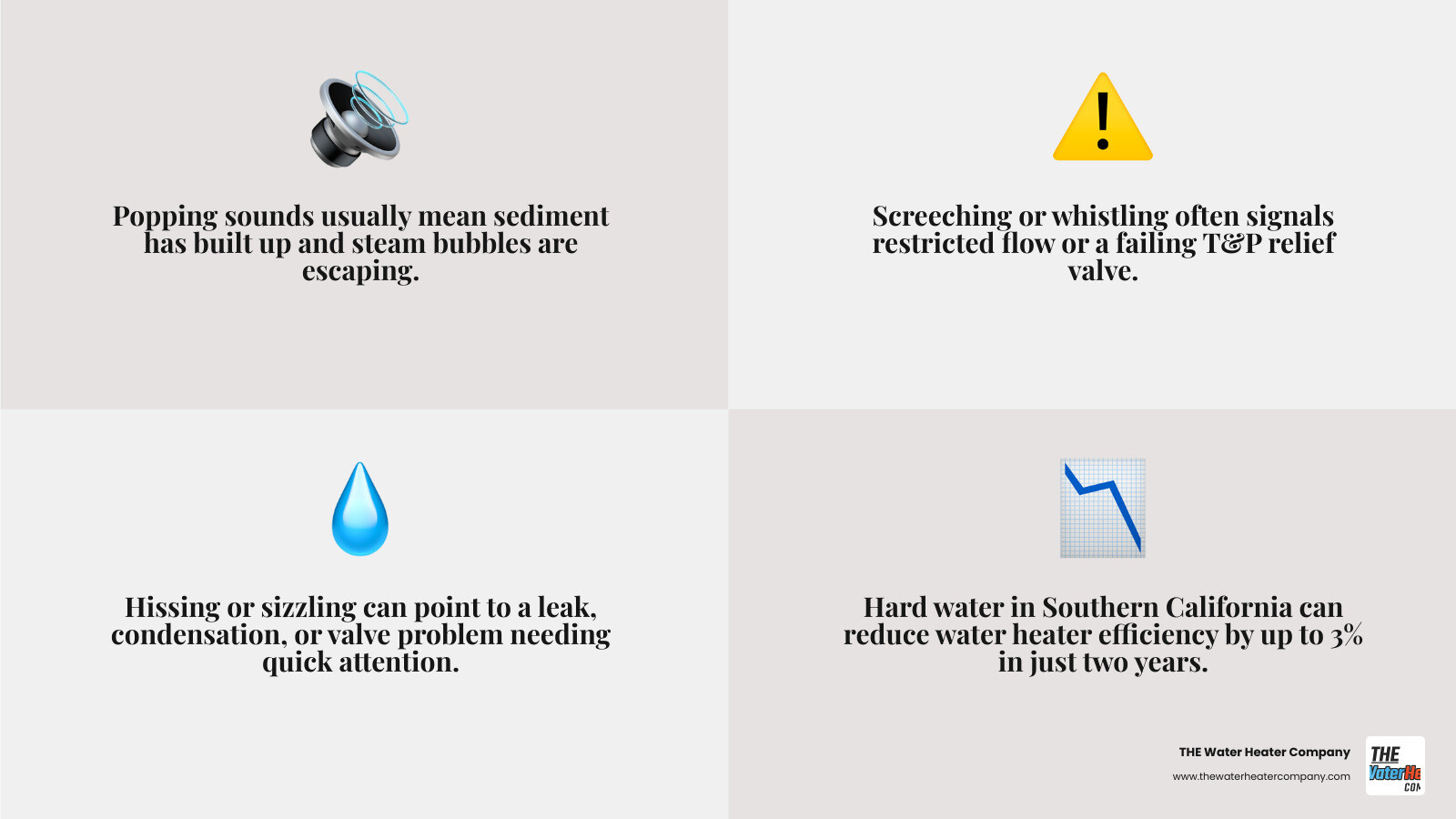
Infographic showing common water heater noises, their causes, and urgency levels for Southern California homeowners

Water heater making strange noises what it means terms simplified:

Deciphering Your Water Heater Making Strange Noises What It Means

When your water heater begins to sound like a science experiment gone wrong, it is performing its own version of acoustic diagnostics. In our years of servicing homes from Santa Barbara down to Irvine, we have learned that these sounds are rarely random. Instead, they are direct indicators of physical and chemical changes occurring inside the appliance.

A sudden increase in operating volume—such as a jump of 10 to 15 decibels—often precedes mechanical failure. If your system is operating above 65 decibels (measured at about three feet away), there is a high probability of internal obstructions or severe pressure imbalances.

The underlying problem is that internal friction and thick mineral layers dramatically reduce heat transfer. When your burner or electric elements have to heat through a thick barrier of stone before they even reach the water, your system experiences a severe drop in efficiency. In fact, heavy sediment buildup can force a water heater to work up to 20% harder, driving up your monthly utility bills. To understand the long-term impact of these minerals, take a look at our guide on How Hard Water and Chemicals Hurt Your Water Heater.
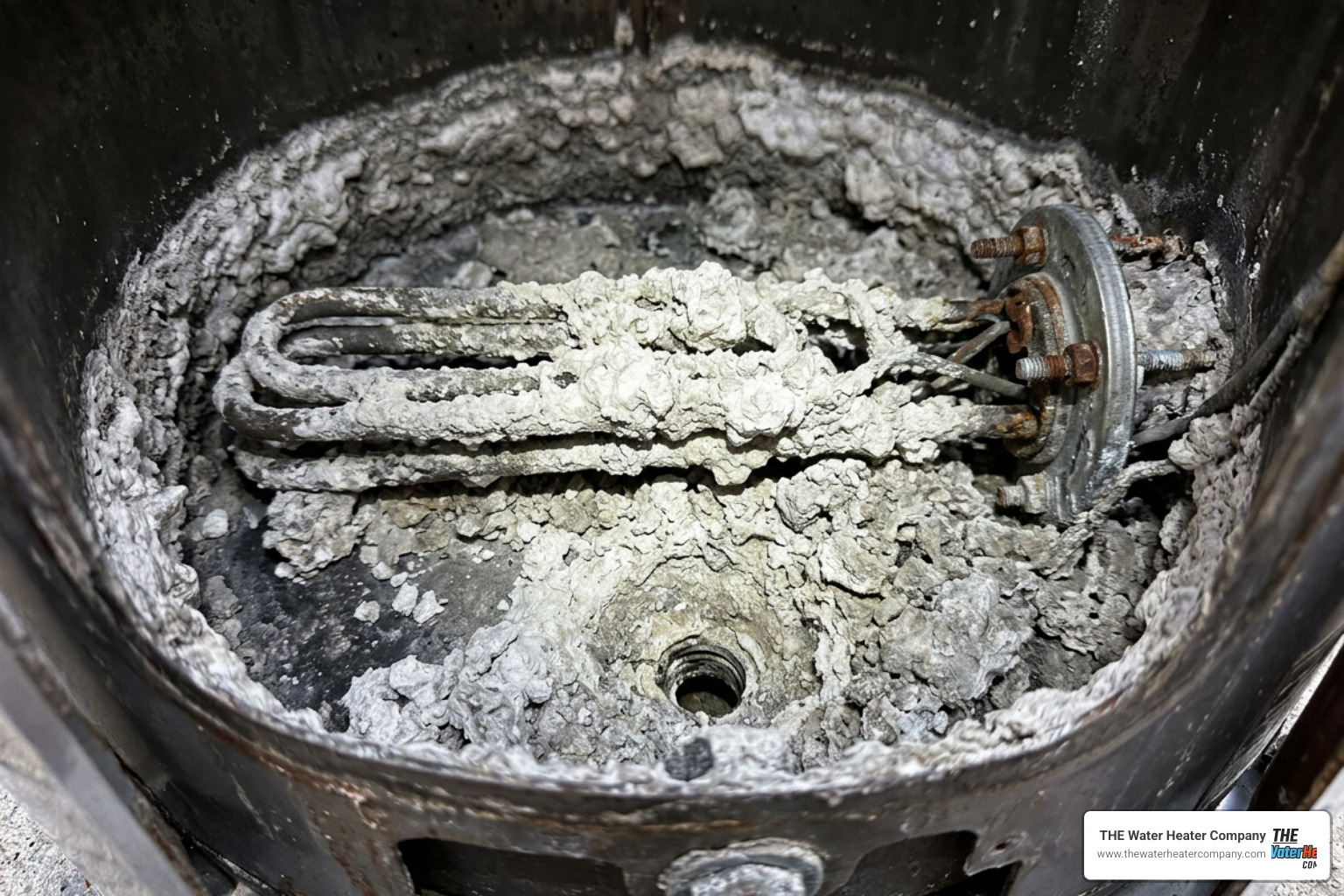
sediment buildup inside a tanked water heater

Popping and Rumbling: Water Heater Making Strange Noises What It Means for Sediment

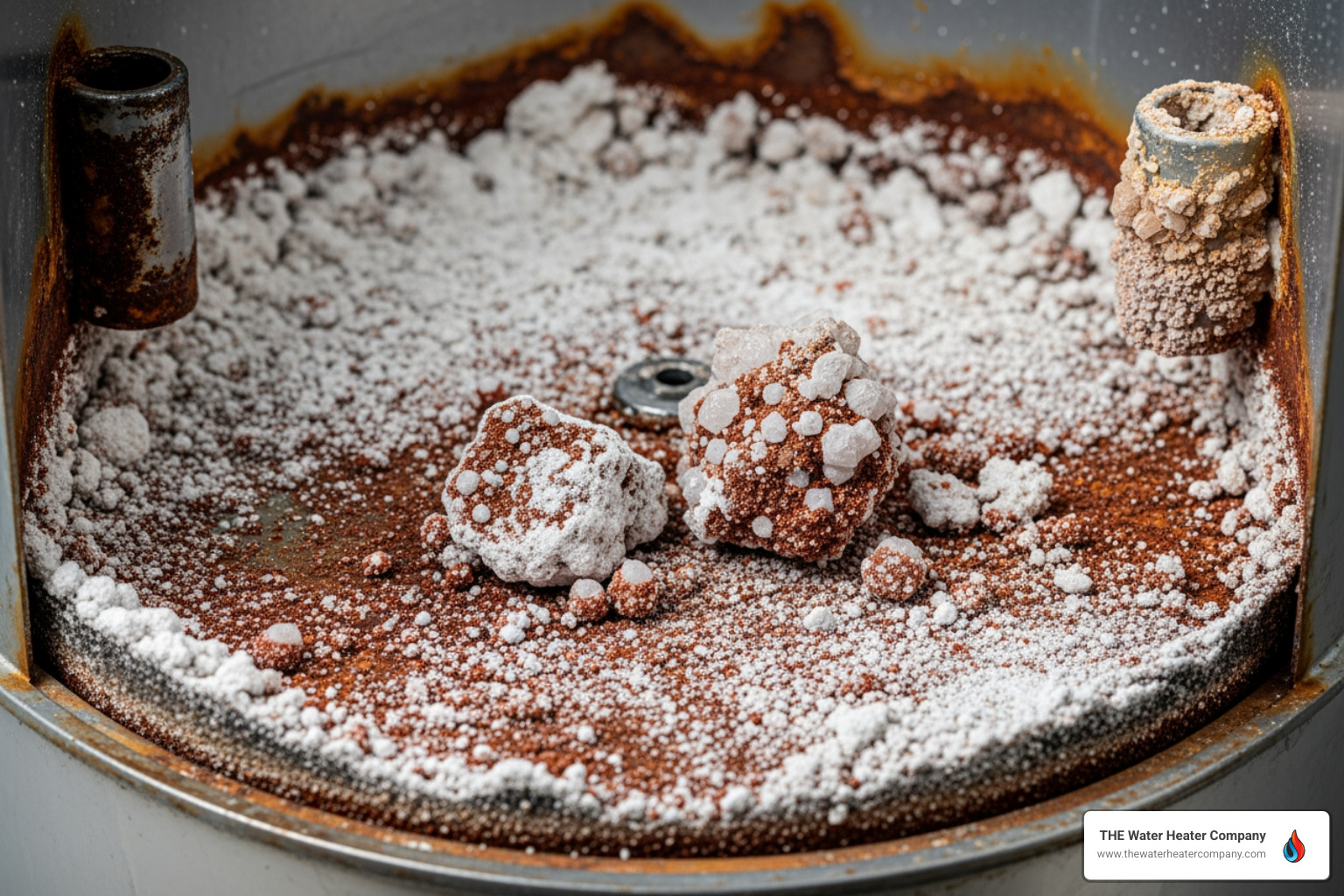
If you hear a distinct popping, cracking, or deep rumbling sound, you are listening to the effects of hard water scale. As Southern California water is heated, dissolved calcium carbonate and magnesium precipitate out of the liquid. These minerals settle at the very bottom of the tank, creating a hardened, crusty barrier directly over the gas burner or surrounding the lower electric heating element.

But how does this create a popping sound?

  1. Water becomes trapped in pockets beneath this hardened mineral layer.
  2. The burner heats the bottom of the tank, causing the trapped water to boil rapidly and turn to steam.
  3. This superheated steam pocket expands until it violently bursts through the crust of sediment to escape into the main tank.

This process is known in the industry as “kettling” because it mimics the boiling action of a tea kettle. The deep rumbling you hear is the sound of these steam bubbles collapsing and shifting large plates of mineral scale around the bottom of your tank. To prevent this from degrading your system, read our expert tips on How to Prevent Sediment Buildup in Your Water Heater for Better Performance.

Screeching and Whistling: Water Heater Making Strange Noises What It Means for Pressure

A high-pitched screeching, whistling, or singing sound is almost always an indicator of restricted water flow or extreme pressure. Water heaters are designed to operate under a balanced flow. If a valve is partially closed, or if mineral scale has narrowed the internal piping, water is forced through a tiny opening at incredibly high velocity, creating a whistling effect.

The most critical component to check when you hear this sound is your Temperature and Pressure (T&P) Relief Valve. This safety valve is designed to open and release water if internal pressures exceed 150 PSI or temperatures surpass 210°F. If the T&P valve is failing, loose, or partially blocked by mineral scale, it may whistle or screech as it struggles to hold back or safely vent the pressure. This is a clear warning sign that should never be ignored. For more details on identifying these critical warning signs, see our breakdown of Signs You Need a Water Heater Repair.

Banging, Hissing, and Ticking Sounds

Other common sounds include:

  • Banging or Knocking (Water Hammer): This sharp, rhythmic thumping occurs when a faucet or appliance valve closes suddenly, sending a shockwave back through your plumbing system. These shockwaves can measure over 300 PSI—more than five times the normal 40 to 60 PSI of a standard residential system—which can damage joints and deform your water heater tank over time.
  • Hissing or Sizzling: On a gas water heater, this is often caused by condensation dripping onto the hot burner assembly. On an electric model, however, a persistent sizzling sound usually means the lower heating element is completely buried in sediment, causing the water immediately surrounding the element to flash boil into steam.
  • Ticking or Clicking: This is typically the result of thermal expansion. As hot water flows through your pipes, the metal or plastic expands and rubs against the wooden framing of your home. It can also be caused by heat trap nipples inside the inlet and outlet connections, which use small internal balls to prevent heat loss; their movement is entirely normal and harmless.
Noise Type Primary Cause Potential Consequence If Ignored
Popping / Kettling Steam escaping from beneath hardened mineral scale Tank overheating, metal fatigue, and tank cracking
Deep Rumbling Heavy sediment shifting during heating cycles Reduced hot water capacity and severe efficiency loss
High Screeching Restricted water control valves or high-velocity flow Strain on plumbing joints and restricted hot water delivery
Screaming / Whistling Failing or active T&P relief valve High-pressure buildup and potential tank rupture
Sharp Banging Water hammer (pressure shockwaves in pipes) Broken pipe fittings, leaks, and damaged tank seams
Sizzling Condensation on gas burner or buried electric elements Burnt-out heating elements or corroded burner assemblies
Ticking / Clicking Thermal expansion of pipes or movement of heat traps Minor cosmetic noise; rarely poses a safety risk

How to Diagnose Water Heater Noises in 5 Easy Steps

Before you attempt to diagnose your water heater, safety must be your absolute priority. Water heaters combine high-voltage electricity or combustible gas with high-temperature, pressurized water. Always turn off the power source (the circuit breaker for electric models or the gas control valve for gas models) if you suspect a major leak or pressure issue.

Step 1: Identify the Sound and Its Timing

The first step is to listen closely to the frequency, volume, and timing of the noise.

  • Does the noise only happen during a recovery cycle? If you hear popping or rumbling only after someone takes a shower or when the burner kicks on, the issue is almost certainly sediment buildup.
  • Does the noise happen when faucets are turned off? If a loud bang echoes through the house right when the washing machine or dishwasher finishes filling, you are dealing with water hammer.
  • Is the noise constant? Continuous hissing or whistling suggests an active leak or a valve that is constantly venting pressure.

Step 2: Determine the Power Source and System Type

How your system is powered changes how it behaves and the types of noises it can make:

  • Gas Water Heaters: These units rely on a burner at the bottom of the tank. Sediment acts as an insulator, trapping heat and causing the metal bottom of the tank to overheat, leading to loud popping and booming sounds.
  • Electric Water Heaters: These systems use upper and lower heating elements that extend directly into the water. If the lower element is buried in sediment, it will produce a distinct sizzling or buzzing sound.
  • Heat Pump (Hybrid) Water Heaters: These systems utilize a compressor and fan assembly, naturally producing a consistent low-level ambient hum of about 45 to 55 decibels. However, grinding, clicking, or loud rattling from a hybrid unit indicates fan or compressor component wear.
  • Tankless Water Heaters: Because they do not store water, they do not suffer from traditional tank rumbling. However, restricted flow from mineral scale inside the narrow heat exchanger can cause a high-pitched whining or whistling sound during operation.

Step 3: Check the Water Pressure and Valves

High water pressure is a silent killer for plumbing systems. Use a simple pressure gauge on an outdoor hose bib to check your home’s PSI. It should ideally sit between 40 and 60 PSI. If your pressure is above 80 PSI, it puts immense stress on your water heater and worsens water hammer.

Next, inspect the T&P relief valve located on the top or side of your tank. Look closely at the discharge pipe connected to it. If you hear a faint whistling or see water dripping from this pipe, the valve is attempting to vent excess pressure or temperature, or the valve itself has failed due to mineral buildup.

Step 4: Inspect for External Leaks or Moisture

Walk around your water heater and inspect the base of the tank, the pipe connections, and the valves for any signs of moisture, rust, or pooling water. A hissing sound accompanied by water pooling around the base of the unit is a major warning sign.

Corrosion on the outer jacket of the tank or around the fittings indicates that water is slowly escaping, which can quickly lead to a catastrophic tank failure. If you discover active pooling or have lost hot water entirely, read our urgent guide on What to Do If Your Water Heater Is Leaking or You Have No Hot Water.

Step 5: Evaluate the Age and Lifespan of the Unit

The age of your system plays a massive role in your diagnostic process. A traditional tanked water heater typically has a lifespan of 8 to 12 years (averaging about 10 years in Southern California due to our water quality). If your tank is over a decade old and has developed persistent, loud rumbling or popping sounds that do not improve after maintenance, the metal has likely suffered thermal fatigue, and the unit is nearing the end of its useful life.

Conversely, a tankless water heater can last up to 20 years with proper maintenance. If your tankless system is making noise, it is highly likely that a professional descaling cycle can completely restore it to quiet, efficient operation. To learn more about what to expect from your system’s lifespan, check out Don’t Get Left in the Cold: How Long Your Water Heater Really Lasts.

Preventive Maintenance: How to Keep Your System Quiet

The single most effective way to prevent and eliminate water heater noises is regular preventive maintenance. By establishing a routine, you can protect your system from the damaging effects of hard water scale and ensure it operates silently.

For standard tank water heaters, we recommend flushing the tank at least once a year—and up to twice a year in areas of Southern California with exceptionally high mineral content.

Here is how a standard sediment flush is performed:

  1. Turn off the power supply (breaker for electric, pilot/off for gas) and shut off the cold water inlet valve.
  2. Connect a standard garden hose to the drain valve at the bottom of the tank and run the other end to a safe drainage location.
  3. Open a hot water faucet upstairs to prevent a vacuum from forming, then slowly open the drain valve.
  4. Let the water drain completely. Once empty, briefly turn the cold water inlet valve back on in short bursts to stir up and wash out any remaining sediment at the bottom of the tank.
  5. Close the drain valve, disconnect the hose, refill the tank completely before turning the power back on, and purge any remaining air from the hot water faucets.

If your system has not been flushed in several years, the sediment may have hardened into a thick, solid plate. In these cases, a simple flush may not be enough, and a professional de-liming treatment or manual scraping may be required. For a deeper look at timing and step-by-step instructions, see The Homeowner’s Guide to Water Heater Flushing Frequency and The Importance of Flushing Your Water Heater and How Often You Should Do It.

Maintenance for Tankless and Heat Pump Systems

Tankless water heaters require a slightly different maintenance approach. Because they use high-efficiency copper heat exchangers with narrow passages, scale builds up quickly on the interior walls, restricting water flow and causing whistling or whining noises. To clear this, tankless systems must be flushed with a food-grade descaling solution or virgin white vinegar using a specialized pump kit. For a comprehensive care plan, refer to our guide on How to Keep Your Tankless Water Heater Happy and Healthy.

For heat pump water heaters, regular maintenance includes cleaning the air filter located on top of the unit. A clogged filter restricts airflow to the evaporator coil, forcing the compressor to work harder and significantly increasing the operating noise of the fan. Keeping this filter clean ensures the unit stays within its normal 45 to 55-decibel operating range. You can explore more general maintenance tips in our comprehensive Water Heater Maintenance 101.

When to Call a Professional Plumber in Southern California

While checking your water pressure or performing a basic annual flush are excellent DIY tasks, there are several scenarios where attempting to fix a noisy water heater yourself can be dangerous.

You should immediately call a professional plumber if:

  • You smell gas or suspect a gas leak: If you hear a hissing sound near the gas connection or burner assembly accompanied by a rotten egg smell, immediately leave the home, shut off your gas main, and call for emergency assistance.
  • The T&P relief valve is actively leaking or whistling: Because this valve is your system’s primary defense against a high-pressure explosion, any malfunction should only be handled by a licensed professional. Never attempt to cap, plug, or tighten a whistling T&P valve.
  • The noise persists after a thorough flush: If your tank continues to pop or rumble after you have flushed it, the sediment has likely hardened into a solid mass, or the tank’s glass lining has begun to crack.
  • You suspect an electrical component failure: Buzzing, clicking, or humming on electric models often points to faulty thermostats or shorted heating elements that require professional diagnostic tools to safely replace.

Working with a licensed specialist ensures that your system is repaired safely, up to local Southern California plumbing codes, and without voiding your manufacturer’s warranty. For more clarity on what is true versus what is a misconception when it comes to your system, check out our guide on 5 Common Myths About Water Heaters Debunked.

Frequently Asked Questions About Noisy Water Heaters

Is a popping water heater dangerous?

In the short term, a popping water heater is not an immediate explosion hazard, but it is a sign of significant stress on the system. The hardened sediment layer causes the bottom of the tank to overheat, which leads to thermal expansion stress. Over time, this constant overheating and cooling causes the metal tank to fatigue and the protective glass lining to crack. Once the glass lining is compromised, water comes into direct contact with the steel tank, leading to rapid corrosion, leaks, and eventually, a ruptured tank.

Why does my water heater only make noise at night?

This is a very common observation for homeowners. During the day, ambient household noise (TVs, traffic, conversations) easily masks the sounds of your water heater. At night, when the house is silent, those sounds become highly audible. Additionally, hot water demand drops significantly overnight. When the water heater finally kicks on to perform a recovery cycle in the quiet hours of the early morning, the popping and rumbling sounds of steam escaping the sediment layer seem much louder and more disruptive.

Can a noisy water heater increase my energy bills?

Yes, absolutely. When a thick layer of mineral scale covers your heating elements or the bottom of your tank, it acts as an insulating blanket. Heat cannot transfer efficiently from the burner or element into the water. As a result, your system must run significantly longer to heat the exact same amount of water, consuming up to 20% more energy. Over time, this drop in efficiency translates directly into higher monthly utility bills.

Conclusion

A noisy water heater is your system’s way of asking for attention. Whether it is a gentle ticking from thermal expansion, a loud pop from Southern California’s notorious hard water sediment, or a high-pitched whistle warning of pressure buildup, listening to your system is the key to preventing costly water damage and premature system failure.

If your water heater is making strange noises and you want to ensure it is diagnosed safely and accurately, we are here to help. At THE Water Heater Company, we are proud to be a local, family-owned Southern California business dedicated to providing fast, reliable, and expert service. We serve communities across Los Angeles, Pasadena, Irvine, Santa Ana, Santa Barbara, Camarillo, Santa Clarita, and Van Nuys, bringing specialized expertise in repairs, maintenance, and advanced water filtration.

Don’t wait for a minor noise to turn into a major headache. Contact us today to schedule our professional water heater repair services and restore peace, quiet, and efficiency to your home.
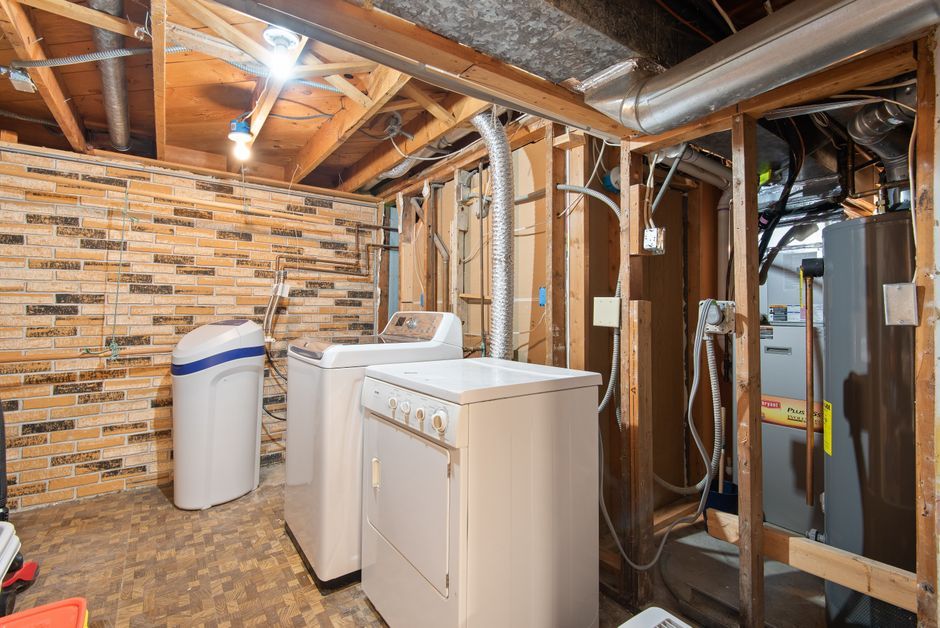
water heater in a modern home utility room with hot water pipes and daily household chores in background

How to Get Rid of Consequences of Skipping Flush

What Happens If You Don’t Flush Your Water Heater — And Why It Matters for Your Home

What happens if you don’t flush your water heater is something most Southern California homeowners never think about — until a cold shower or a spike in the energy bill forces the question. Here’s the short answer:

If you skip flushing your water heater, you can expect:

  • Sediment buildup — Minerals like calcium and magnesium settle at the bottom of your tank over time, forming a thick layer of sludge
  • Higher energy bills — That sediment acts as insulation between the burner and the water, forcing your unit to work harder; a quarter-inch of buildup alone can reduce efficiency by 25–40%
  • Strange noises — Popping, rumbling, or banging sounds are a sign that sediment is being heated underneath the water
  • Rusty or cloudy water — Corrosion from neglected sediment can contaminate your hot water supply
  • Shorter lifespan — A well-maintained water heater can last 12 years or more; without flushing, you may face early replacement in as few as 8 years
  • Reduced hot water capacity — Compacted sediment takes up real space inside your tank, meaning less hot water for your household
  • Safety risks — Sediment can clog the pressure relief valve, creating a dangerous pressure buildup inside the tank

Most of these problems build slowly and quietly — which is exactly what makes skipped maintenance so costly in the long run.

I’m Anthony Hamilton, Co-Founder and CEO of THE Water Heater Company, and after years working in the field and serving thousands of Southern California homeowners, I’ve seen what happens if you don’t flush your water heater — from minor efficiency loss all the way to full tank failure that could have been avoided with one simple annual step. In this guide, I’ll walk you through every consequence of skipping this maintenance task and exactly what you can do about it.

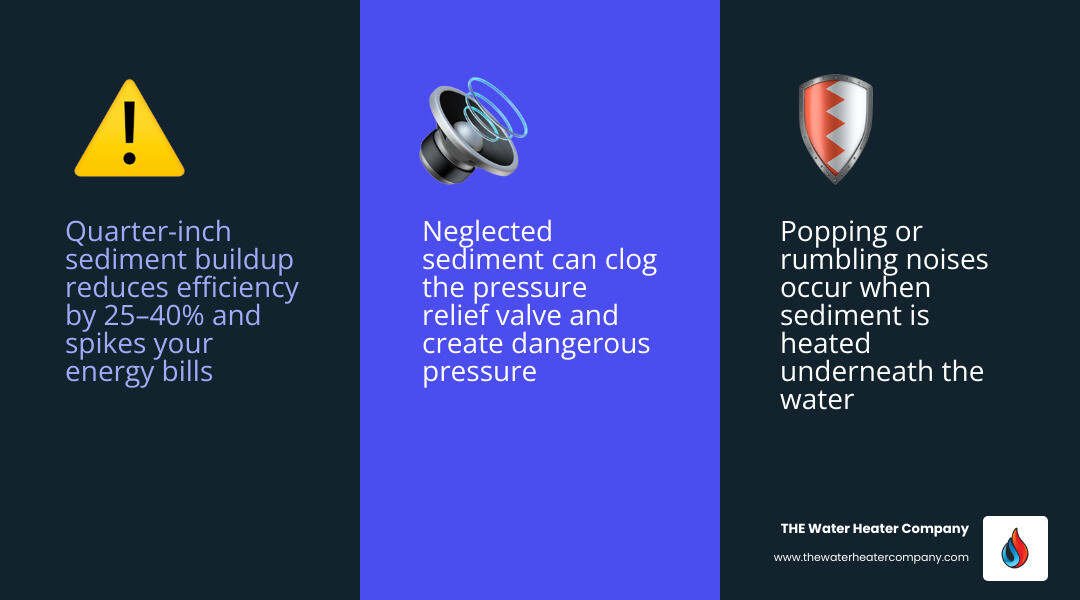
Infographic showing consequences of skipping water heater flushing: sediment buildup, efficiency loss, noisy operation

What happens if you dont flush your water heater?

When we talk about the health of your plumbing system, we often focus on the pipes we can see. But inside your water heater, a chemical process is happening every single day. As water is heated, minerals like calcium carbonate and magnesium salts naturally precipitate out of the liquid. These minerals are heavier than water, so they sink to the bottom.

Close-up of thick sediment and mineral buildup inside a cutaway water heater tank

If you never perform a flush, this “snowfall” of minerals eventually turns into a thick, rocky layer of sludge. This isn’t just a bit of dirt; it’s a physical barrier that wreaks havoc on your system. The Importance of Flushing Your Water Heater and How Often You Should Do It cannot be overstated, especially in Southern California where hard water is a common reality for residents from Santa Barbara to Irvine.

The Cost of Efficiency Loss

The U.S. Department of Energy has noted that even a quarter-inch of sediment can reduce your system’s efficiency by 25% to 40%. In a gas-powered tank, the burner is located at the bottom. When sediment sits on that bottom floor, the burner has to heat the sediment before it can even begin to heat the water. This leads to massive energy bills and puts the metal tank under extreme thermal stress.

Tank Corrosion and Internal Rust

Sediment doesn’t just sit there; it traps moisture against the tank’s steel walls and can actually bury the anode rod—the component designed to protect your tank from rusting. When the anode rod is buried in “sludge,” it can’t do its job. This leads to internal rust and, eventually, a catastrophic leak. Don’t Get Left in the Cold: How Long Your Water Heater Really Lasts often depends on whether you’ve allowed this corrosion to take root.

Warning Signs Your System Needs Immediate Attention

Your water heater is actually quite communicative; you just need to know what to listen and look for. If you’ve been wondering what happens if you dont flush your water heater, your ears might give you the first clue.

Rumbling and Popping Noises

Have you ever heard a sound like popcorn popping or a low rumbling coming from your utility closet? That isn’t “ghosts” in the pipes. It is actually the sound of steam bubbles escaping from underneath the heavy layer of sediment at the bottom of the tank. As the water trapped under the sludge boils, it “pops” through the layer, which can eventually crack the protective glass lining of your tank.

Cloudy or Rusty Water

If your hot water looks “milky” or has a reddish-brown tint, it’s a clear indicator of sediment or active corrosion. This is one of the primary Signs You Need a Water Heater Repair. This sediment can also migrate into your faucets and showerheads, clogging the aerators and reducing your home’s water pressure.

Inconsistent Temperatures and Reduced Capacity

If you find that your showers are getting shorter or the water never seems to get as hot as it used to, sediment is likely the culprit. In a 50-gallon tank, several inches of compacted sediment can displace gallons of water, effectively turning your large heater into a much smaller one. When performance drops this significantly, you have to ask: Should I Repair or Replace My Water Heater?

Maintenance Requirements for Different Systems

Not all water heaters are created equal. Depending on whether you have a traditional tank or a modern tankless unit, the consequences of skipping maintenance look a bit different.

Feature Tank-Style Water Heater Tankless Water Heater
Primary Issue Sediment/Sludge Accumulation Limescale on Heat Exchanger
Risk of Neglect Tank Corrosion & Leaks System Shutdown & Error Codes
Maintenance Task Draining & Flushing Chemical Descaling
Frequency Once a year (Standard) 6-12 months (Hard Water)

In Southern California, our water is notoriously “hard,” meaning it contains high levels of dissolved minerals. Whether you are in Pasadena or Santa Clarita, Tank vs Tankless Water Heaters both require a proactive approach. How to Maintain Your Southern California Tankless Water Heater involves specific steps to combat the local water profile.

Scale buildup and what happens if you dont flush your water heater (tankless)

Tankless units don’t have a big vat to collect sludge, but they do have a heat exchanger with very narrow passages. Hard water creates “scale”—a hard, crusty mineral coating—inside these passages. Why Descaling is the Secret to a Long Tankless Life is simple: if you don’t descale, the unit will eventually overheat, throw error codes, and stop providing hot water entirely.

Sediment compaction and what happens if you dont flush your water heater (tank-style)

For traditional tanks, the biggest threat is sediment compaction. Over years of neglect, the loose “sand” at the bottom can harden into something resembling concrete. This layer destroys the efficiency of the heating elements in electric models and can lead to bacterial growth, including sulfate-reducing bacteria that create a “rotten egg” smell. Learning How to Prevent Sediment Buildup in Your Water Heater for Better Performance is the best way to avoid this sludge layer.

How to Safely Flush Your Water Heater

If you’re feeling handy, you can attempt a flush yourself, but safety should always be your first priority. The water inside your tank can be 140 degrees or hotter—enough to cause severe burns instantly.

  1. Turn off the Power: For gas heaters, turn the dial to “Pilot.” For electric heaters, shut off the breaker.
  2. Shut off the Water: Close the cold water inlet valve.
  3. Connect a Hose: Attach a standard garden hose to the drain valve at the bottom and run it to a floor drain or outside.
  4. Open the TPR Valve: Carefully open the Temperature and Pressure Relief valve to allow air in so the water can flow out.
  5. Drain and Flush: Open the drain valve. To really get the sediment out, we recommend the “cold-water stir”—briefly turning the cold water supply back on to swirl the sediment around so it can be flushed out.
  6. Check the Discharge: Keep flushing until the water coming out of the hose is crystal clear.

For those with tankless systems, Everything You Need to Know About Tankless Water Heater Maintenance involves a circulation pump and food-grade white vinegar to dissolve scale. If you’ve never done this before, or if your unit is more than five years old and has never been serviced, a professional inspection is highly recommended to avoid damaging the components.

Frequently Asked Questions

How often should I flush my water heater in May 2026?

As we look at the current water quality reports for May 2026, we still recommend a baseline of once per year. However, if you live in a particularly hard water area like Camarillo or Santa Ana, or if you have a large household with high hot water usage, you should consider flushing every six months. Following The Homeowner’s Guide to Water Heater Flushing Frequency will help you stay on track.

Can flushing an old or neglected water heater cause leaks?

This is a very real concern. In some neglected tanks, the sediment actually acts as a “plug” for small pinhole leaks that have developed due to corrosion. When you flush that sediment away, you might “un-plug” a leak. If your heater is over 10 years old and has never been flushed, it’s best to have a professional evaluate it first.

Does a clear flush mean my tank is clean?

Not necessarily. This is a “false security” trap. If you haven’t flushed in five years and the water comes out clear immediately, it often means the sediment has compacted into a solid block that the water is simply flowing over. In these cases, a professional descaling or a specialized cleaning tool is needed to break up the hardened scale.

Conclusion

Understanding what happens if you dont flush your water heater is the first step toward saving money and ensuring your family always has a reliable supply of hot water. From avoiding the “rumble” of sediment to preventing a thousand-dollar replacement, a little bit of maintenance goes a long way.

At THE Water Heater Company, we are proud to be the trusted local authority for Southern California homeowners. Whether you need a routine flush, a complex descaling for a tankless unit, or an emergency Water Heater Repair, our expert team is ready to help. We serve the following communities with pride:

  • Santa Barbara
  • Camarillo
  • Santa Clarita
  • Pasadena
  • Van Nuys
  • Los Angeles
  • Santa Ana
  • Irvine

Don’t wait for your water heater to start complaining. Contact us today to schedule your annual maintenance and keep your home running smoothly!

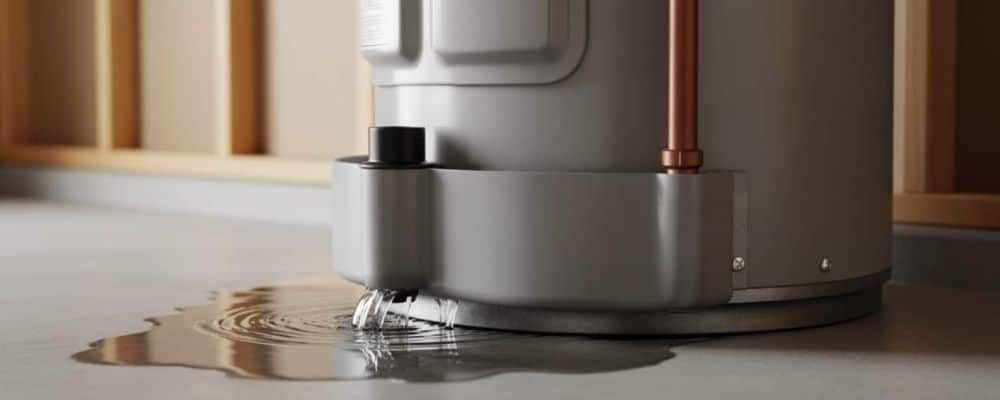
water heater leaking from the bottom puddle on utility room floor

How to Diagnose a Water Heater Leaking From the Bottom

What a Water Heater Leaking From the Bottom Actually Means

Water heater leaking from the bottom what it means is almost never good news — but the cause can range from a simple valve fix to full tank failure. Here’s a quick breakdown:

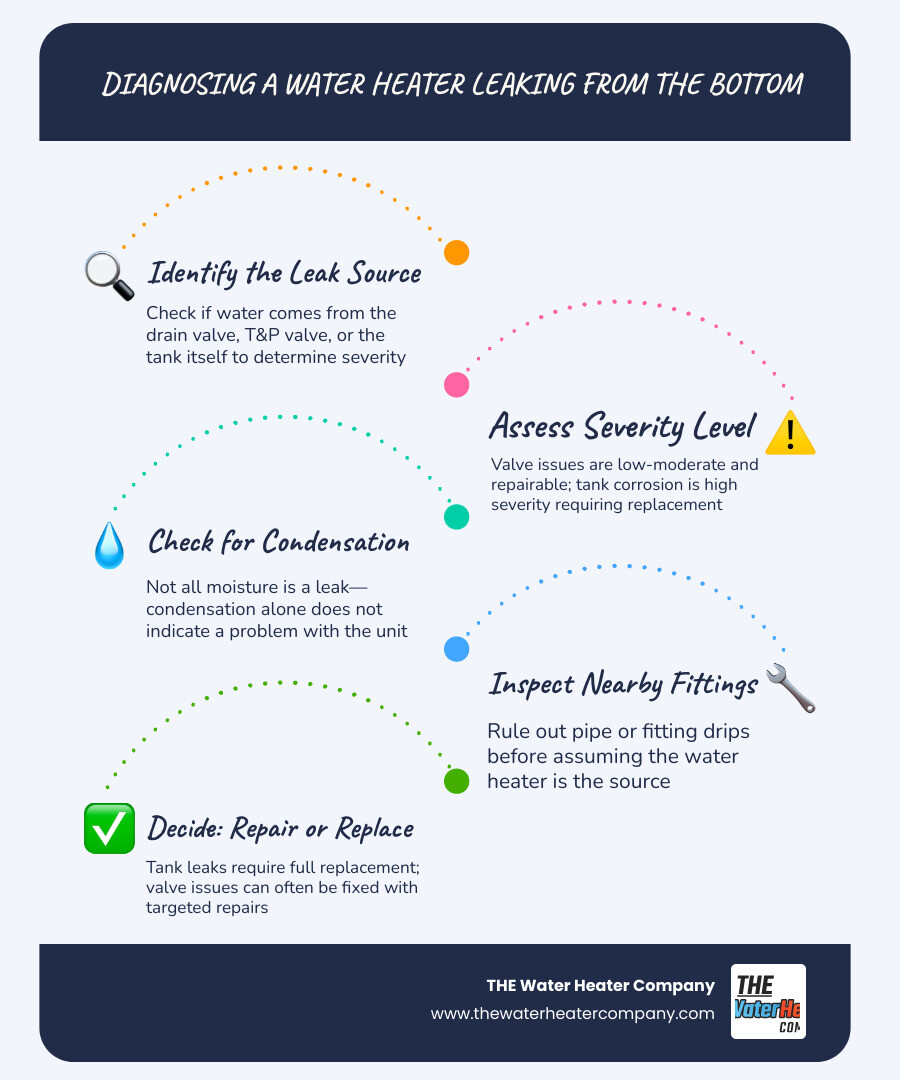
Possible Cause Severity Typically Repairable?
Loose or faulty drain valve Low to moderate Yes
T&P relief valve discharge Moderate Yes (valve replacement)
Internal tank corrosion High No — replacement required
Condensation None Not a leak
Nearby pipe or fitting drip Low to moderate Yes

The bottom line: if water is coming from the tank itself, you’re likely looking at a full replacement. If it’s coming from a valve or nearby component, a repair may be all you need.

Finding a puddle under your water heater is one of those moments that stops you in your tracks. According to industry data, roughly 14,000 U.S. homeowners face a water leak disaster every single day — and water heater failures are a major contributor. In Southern California homes, where hard water and aging infrastructure are common, bottom leaks are a frequent and urgent problem that deserves immediate attention.

I’m Anthony Hamilton, Co-Founder and CEO of THE Water Heater Company, and after years in the field diagnosing exactly this kind of issue — a water heater leaking from the bottom what it means for your tank, your home, and your family’s safety — I’ll walk you through everything you need to know. Let’s start with the most common causes and what they tell you about the health of your system.

infographic showing 4 causes of water heater bottom leaks with severity levels and repair vs replace guidance infographic

Water heater leaking from the bottom what it means terms to know:

Water Heater Leaking from the Bottom: What It Means

When you spot water pooling at the base of your unit, it is crucial to understand the mechanics of what is happening inside the metal jacket. Your water heater is not just a simple metal bucket; it is a highly engineered, pressurized system designed to hold between 40 and 80 gallons of water under constant pressure (usually between 50 and 80 PSI).

A bottom leak is a clear signal that either an external component has failed or the internal structural integrity of the tank has been compromised. External component failures — such as a faulty valve or loose connection — are highly manageable and typically only require target repairs. However, when the leak originates from the inner tank itself, it usually points to irreversible internal corrosion. Understanding these differences can help you determine whether you are dealing with a minor maintenance task or an urgent system failure. Recognizing these early Signs You Need a Water Heater Repair can save you from catastrophic property damage.

Is a Water Heater Leaking from the Bottom What It Means for Your Tank’s Lifespan?

The average storage tank water heater has a typical service life of 8 to 12 years. If your unit is approaching or has exceeded this window, a bottom leak is often the final chapter of its operational lifespan.

Inside every tank water heater sits a crucial component known as the sacrificial anode rod. This rod is made of highly active metals like magnesium, aluminum, or zinc. Its sole job is to attract corrosive elements in the water, sacrificing itself to protect the steel tank lining from rust. Over a period of 3 to 5 years, this rod completely degrades. Once the anode rod is fully depleted, the corrosive minerals in the water turn their attention to the steel walls of your tank. This leads to electrochemical degradation, thin spots, and eventual pinhole leaks near the bottom seam.

If your water heater is older and starts weeping water from its base, it is a strong indicator that the tank has reached its natural end of life. To protect your home from sudden flooding, it is helpful to learn Don’t Get Left in the Cold: How to Spot a Dying Water Heater before a complete rupture occurs.

Understanding a Water Heater Leaking from the Bottom: What It Means for Safety

A leaking water heater is far more than a simple inconvenience; it is a serious safety hazard that should never be ignored. Leaving a bottom leak unaddressed can quickly lead to severe consequences:

  1. Water Damage & Structural Issues: A slow, undetected drip can warp floorboards, rot support beams, and ruin drywall in adjacent rooms.
  2. Mold and Mildew Growth: Damp, warm spaces around a leaking water heater are prime breeding grounds for toxic black mold, which can impact your indoor air quality and family’s health within 24 to 48 hours.
  3. Electrical and Gas Hazards: For electric water heaters, pooling water near the lower heating element or electrical access panels can cause short circuits or severe shock hazards. For gas units, water dripping onto the burner assembly can disrupt the pilot light or lead to gas line corrosion.
  4. Catastrophic Tank Burst: A compromised steel shell operating under high municipal water pressure can fail completely without warning, instantly releasing dozens of gallons of hot water into your home.

If you find yourself facing an active leak, knowing What to Do If Your Water Heater Is Leaking or You Have No Hot Water is your first line of defense to keep your home and family safe.

Common Causes of Bottom Leaks and How to Spot Them

To accurately diagnose a bottom leak, we must systematically narrow down the source. Water naturally travels downward, meaning a leak that appears at the bottom of the unit could actually be dripping from a loose connection at the top of the tank and running down the side jacket.

Before assuming your tank has failed, dry the entire unit with a towel and observe the key points of connection.

technician inspecting the drain valve and base of a water heater with a flashlight

Here is a quick reference table to help you distinguish between a simple drain valve issue and a terminal tank crack:

Feature Leaking Drain Valve Cracked or Corroded Tank
Water Location Dripping directly from the valve nozzle or threaded connection Pooling under the jacket, seeping from bottom seams
Water Quality Often clear, but may contain white mineral flakes Frequently rusty, muddy, or discolored
Leak Pattern Consistent dripping or slow, steady stream Can start as an intermittent drip and rapidly worsen
Repair Option Replace the valve with a durable brass model Complete water heater replacement

Faulty Temperature & Pressure (T&P) Relief Valve

The Temperature & Pressure (T&P) relief valve is a critical safety device installed on every storage water heater. It is designed to open and discharge water through a dedicated discharge tube if the internal temperature exceeds 210°F or if the pressure exceeds 150 PSI. This prevents the tank from over-pressurizing and potentially exploding.

The discharge tube of the T&P valve typically runs down the side of the water heater and terminates within 6 inches of the floor or drain pan. If you see water pooling around the bottom of this tube, it means the T&P valve is doing its job and releasing water. This can happen for two reasons:

  • Thermal Expansion: In closed plumbing systems (common in many Southern California cities like Pasadena and Irvine), water expands as it heats up. With nowhere to go, this expansion causes dramatic pressure spikes that force the T&P valve to open.
  • Faulty Valve: Over time, the internal spring of the T&P valve can weaken, or mineral scale can build up on the seal, preventing it from closing fully.

If the T&P valve is leaking even when water pressure and temperatures are within safe parameters, the valve itself must be professionally replaced.

Leaking Drain Valve

The drain valve is located near the very bottom of your water heater tank and is used to flush sediment during routine maintenance. Many standard residential water heaters come equipped with cheap, plastic drain valves from the factory.

Over time, these plastic valves can degrade, warp, or crack due to constant heat exposure. Additionally, when sediment settles at the bottom of the tank, mineral debris can get trapped inside the valve seat when it is opened and closed, preventing it from sealing completely.

If you notice water dripping directly from the threaded opening of the drain valve or around its base where it threads into the tank, try gently tightening the handle. If it continues to drip, the plastic valve should be replaced with a high-quality, full-port brass drain valve.

Internal Tank Corrosion and Seam Leaks

The most serious cause of a bottom leak is a breach in the inner steel tank. Modern storage water heaters are constructed with a heavy steel outer shell and a vitrified glass or ceramic lining on the inside to protect the steel from water contact.

However, over years of constant thermal expansion and contraction (heating and cooling cycles), this glass lining can develop microscopic cracks. Once water makes direct contact with the underlying steel, rust begins to form. This electrochemical degradation eventually eats through the steel shell, resulting in pinhole leaks.

When this happens, water will seep out from behind the outer metal jacket or drip from the bottom seam of the heater. Because the pressurized steel tank cannot be safely welded or patched, a tank seam leak is a terminal failure that requires a professional Water Heater Replacement.

Hard Water and Sediment Accumulation

Southern California is notorious for having highly mineralized municipal water. Cities like Santa Ana, Los Angeles, and Santa Clarita often have hard water packed with calcium and magnesium.

As water is heated inside your tank, these dissolved minerals precipitate out of the water and settle to the bottom as solid sediment. This layer of sediment acts as an insulating barrier between the gas burner (or electric element) and the water.

This causes several major problems:

  • Thermal Stress: The bottom of the tank must get much hotter than designed just to heat the water through the thick layer of sediment, causing severe thermal stress and cracking the glass lining.
  • Sediment Sizzling: You may hear popping, rumbling, or sizzling sounds as water trapped beneath the sediment layer boils and turns to steam.
  • Accelerated Corrosion: The localized overheating accelerates the breakdown of the steel tank base, leading to early failure.

If your water heater is struggling under these conditions, prompt Water Heater Repair and a thorough tank flush can help mitigate the damage before a total leak occurs.

Should You Repair or Replace Your Leaking Water Heater?

When faced with a water heater leaking from the bottom, the big question is always: Can I fix this, or do I need a new one?

The answer depends entirely on the source of the leak and the age of your unit.

If the leak is traced to a faulty drain valve, a worn-out T&P valve, or a loose pipe connection at the top of the tank, these are highly repairable issues. A skilled plumber can quickly swap out these components, extending the life of your current system.

However, if the leak is coming from the internal tank shell itself, repair is simply not an option. A compromised pressurized vessel cannot be safely patched. Attempting to weld or seal a leaking tank is a safety hazard that can lead to a catastrophic rupture.

To help you make an informed decision, consider these guidelines:

  • Under 6 Years Old: If the tank is still under warranty and experiencing a valve leak, repair is almost always the right path. If the tank itself has failed, it may be covered under the manufacturer’s replacement warranty.
  • 6 to 10 Years Old: The decision depends heavily on the source of the leak and the overall condition of the unit. If there is heavy rust around the base, replacement is usually the most cost-effective long-term choice.
  • Over 10 Years Old: At this stage, even if the leak is coming from a repairable component like a drain valve, investing in repairs is often a temporary fix. The tank is likely nearing the end of its reliable lifespan, and a proactive replacement is highly recommended.

For a deeper dive into making this decision, check out our guides on Should I Repair or Replace My Water Heater? and How to Know When to Repair or Replace Your Water Heater.

Frequently Asked Questions About Bottom Leaks

Is a water heater leaking from the bottom dangerous?

Yes, it can be. Beyond the immediate risk of severe water damage and structural rot, a bottom leak can create serious electrical hazards if water contacts the electrical components of an electric unit. For gas units, water can damage the control valve or burner. Additionally, a heavily corroded tank operating under high pressure carries a risk of a sudden, catastrophic burst, which can flood your home with hot water in seconds.

Can a bottom leak be repaired without replacing the whole unit?

It depends entirely on the source. If the leak is coming from the drain valve or the T&P relief valve discharge tube, yes — these components can be easily replaced. However, if the water is leaking from the internal tank shell or seeping out from the bottom metal seams, it cannot be repaired and the entire unit must be replaced.

How can I prevent my water heater from leaking from the bottom?

The best way to prevent bottom leaks is through regular maintenance:

  1. Annual Flushing: Flush your water heater tank at least once a year to remove mineral sediment buildup, especially in hard-water areas of Southern California.
  2. Anode Rod Replacement: Have a professional check and replace your sacrificial anode rod every 3 to 5 years to keep the inner steel tank protected from corrosion.
  3. Pressure Monitoring: Ensure your home’s water pressure does not exceed 80 PSI, and install a thermal expansion tank if you have a closed plumbing system.

Conclusion

A water heater leaking from the bottom what it means for your home is simple: it is an issue that requires prompt, expert attention. Whether it is a quick valve replacement or a complete system upgrade, ignoring a leak can turn a manageable issue into a major home disaster.

At THE Water Heater Company, we are dedicated to providing the highest level of service, transparency, and reliability. As a local, family-owned business, we serve communities across Southern California, including Santa Barbara, Camarillo, Santa Clarita, Pasadena, Van Nuys, Los Angeles, Santa Ana, and Irvine. We specialize in expert diagnostics, targeted repairs, and high-quality installations to keep your home comfortable and safe.

Don’t wait for a small drip to turn into a major flood. Schedule expert water heater repair services with our friendly, experienced team today!

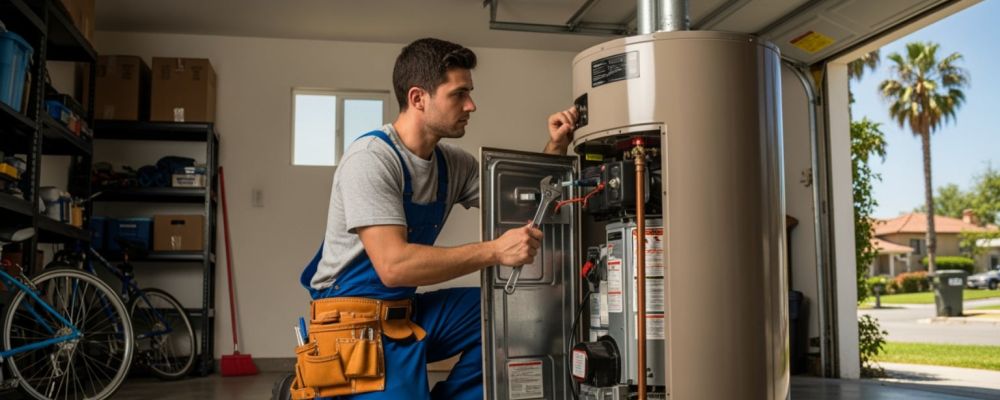
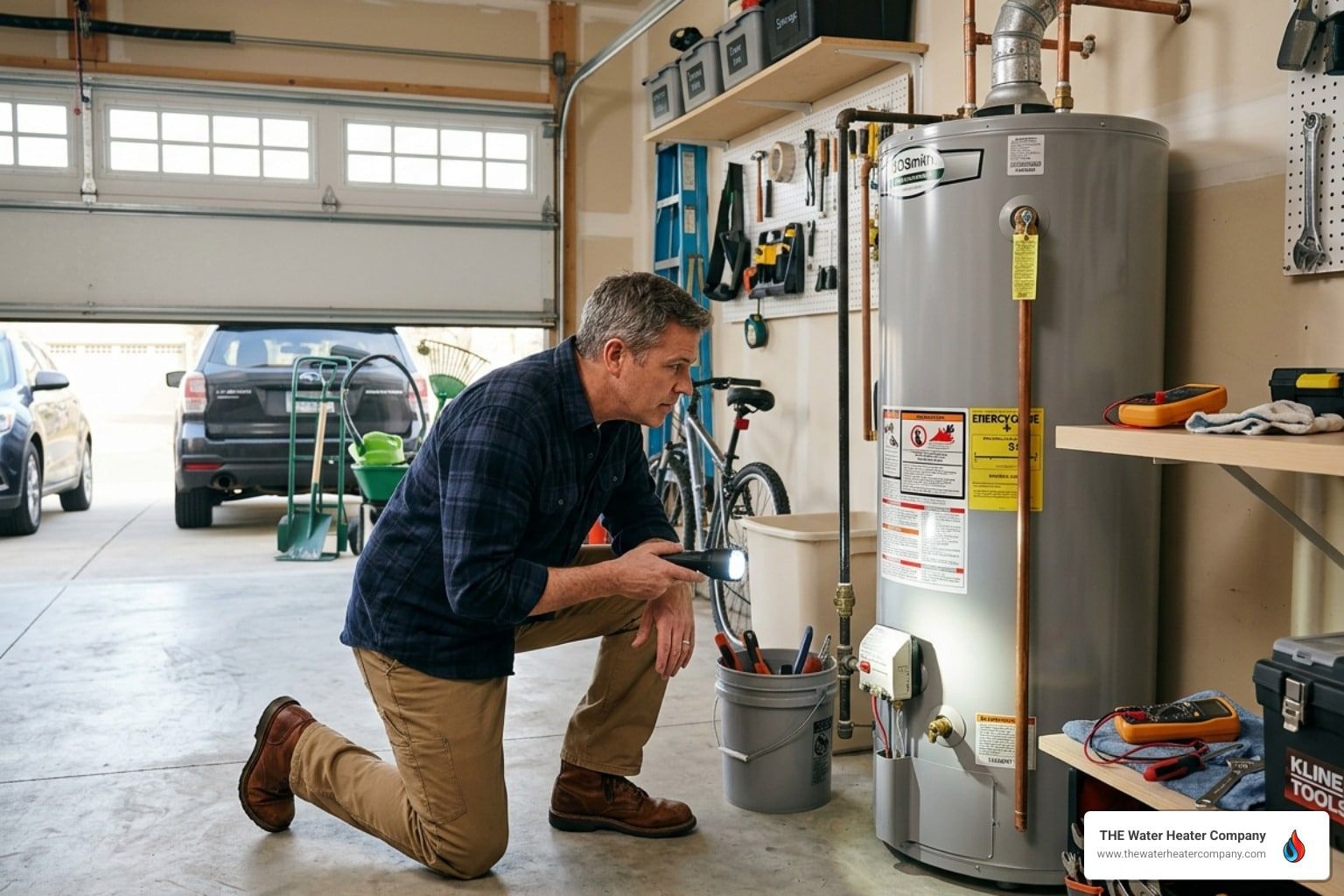
homeowner inspecting water heater in a garage - signs your water heater needs repair or replacement

Don’t Get Left in the Cold: How to Spot a Dying Water Heater

Is Your Water Heater Trying to Tell You Something? Here’s What to Watch For

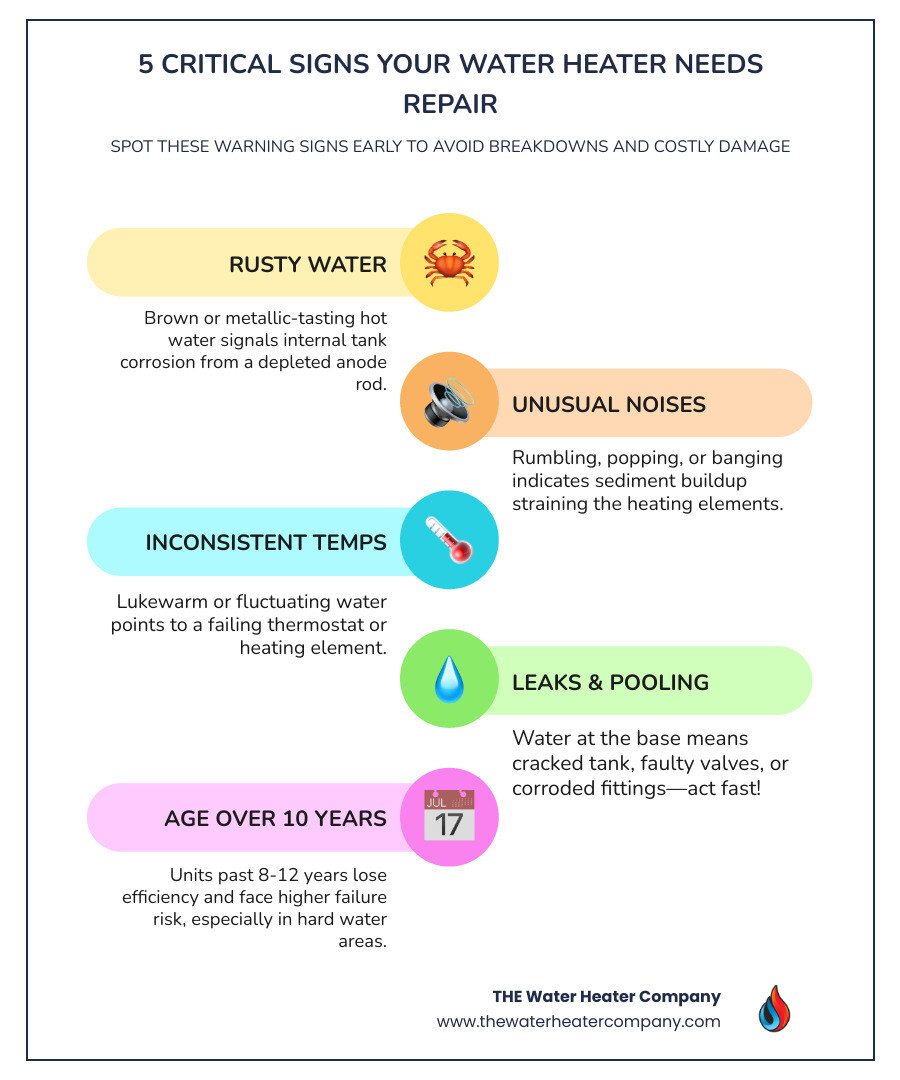
The signs your water heater needs repair or replacement are often hiding in plain sight — and catching them early can save you from a cold shower, a flooded utility room, or a sky-high energy bill. Here’s a quick look at the most common warning signs:

  • Rusty or discolored hot water — internal tank corrosion or a failing anode rod
  • Rumbling, popping, or banging noises — sediment buildup forcing the system to work harder
  • Inconsistent or lukewarm water temperatures — a failing thermostat or heating element
  • Visible leaks or pooling water — cracked tank, faulty valves, or corroded fittings
  • Unit age over 10 years — efficiency declines sharply; failure risk increases significantly
  • Frequent repairs — when breakdowns become routine, replacement is usually the smarter move
  • Rising energy bills — an aging or sediment-clogged unit burns more energy to do less work

Most tank-style water heaters last between 8 and 12 years. If yours is approaching or past that window — especially here in Southern California where hard water accelerates wear — it’s worth paying close attention.

The good news? Most of these warning signs show up well before a full breakdown. Knowing what to look for gives you time to make a smart, calm decision instead of an emergency one.

I’m Anthony Hamilton, Co-Founder and CEO of THE Water Heater Company, and after years in the field diagnosing and replacing water heaters across Southern California, I’ve seen how homeowners miss the early signs your water heater needs repair or replacement — until it’s too late. In this guide, I’ll walk you through exactly what to look for and what to do next.

Infographic showing top 5 water heater failure warning signs with icons and brief descriptions - signs your water heater

5 Critical Signs Your Water Heater Needs Repair or Replacement

Your water heater is the silent workhorse of your home. Whether you are in Pasadena or Irvine, you rely on it every single day for showers, dishes, and laundry. However, because these units are often tucked away in a garage or a closet, we tend to ignore them until the water turns ice cold.

One of the most immediate red flags is water pooling at the base of the tank. If you notice moisture, drips, or a small puddle, do not wait. While a leaking valve might be a simple fix, a leak from the tank itself usually means the internal structure has fractured. In our experience serving Southern California, a leaking tank is a ticking time bomb that can lead to significant property damage.

Another major indicator is inconsistent temperatures. If your morning shower starts hot but turns lukewarm within minutes, your unit is struggling. This often points to a failing heating element in electric models or a burner issue in gas units. When you start experiencing these signs your water heater needs repair or replacement, it is time to have a professional technician take a look. If the unit is older and the repairs are becoming frequent, choosing a full replacement is often the most cost-effective long-term solution.

Rusty Water: One of the Most Common Signs Your Water Heater Needs Repair or Replacement

Have you ever turned on the hot tap only to see brown-tinged or “rusty” water? If the cold water runs clear but the hot water looks like tea, the problem is almost certainly inside your water heater.

Inside every tank-style water heater is a “sacrificial anode rod.” Its job is to attract corrosive elements in the water so they eat the rod instead of the tank. Once that rod is depleted, the water begins to eat the steel tank itself. This leads to internal tank corrosion, which manifests as rusty water and a metallic taste or smell.

If you catch this early, we might be able to replace the anode rod and save the unit. However, once the tank itself starts to flake and rust, the structural integrity is compromised. For homeowners concerned about water quality and system longevity, we often recommend exploring water filtration and conditioning to protect your new investment from the harsh minerals found in local water supplies.

Unusual Noises and Other Signs Your Water Heater Needs Repair or Replacement

If your water heater sounds like it’s boiling a pot of marbles, you’re hearing sediment buildup. Over time, minerals like calcium and magnesium settle at the bottom of the tank. As the burner heats the water from below, steam bubbles get trapped under this layer of “crust” and eventually pop.

These rumbling, popping, or banging noises are more than just annoying—they are a sign of extreme stress. The layer of sediment acts as an insulator, forcing the heating element to work much harder and run longer to heat the water. This causes the metal to overheat and eventually become brittle, leading to cracks.

Regular maintenance for traditional tank water heaters can help mitigate this, but if the banging has been going on for years, the damage to the tank floor may already be done.

Deciding Between Professional Repair and Full Replacement

When a breakdown occurs, the big question is: do I fix it or start fresh? In April 2026, with energy standards being higher than ever, the decision often comes down to a few key factors. We generally suggest using the 50% rule: if the cost of the repair exceeds 50% of the cost of a new unit, replacement is the smarter move.

Factor Consider Repair Consider Replacement
Age Under 8 years old Over 10-12 years old
Repair Cost Minor (valves, pilot light) Over 50% of new unit cost
Frequency First time issue Multiple repairs in 12 months
Efficiency High Noticeable decline/rising bills
Tank Status Sealed and dry Leaking or visible rust

A standard tank water heater has a lifespan of 8-12 years. If your unit is in that double-digit range, investing in a major repair is often throwing good money after bad. Newer models are significantly more energy-efficient and can save you hundreds of dollars on utility bills over their lifetime. To help make the transition easier, we offer various financing options and frequently update our current specials for Southern California families.

The Role of Southern California Hard Water in System Failure

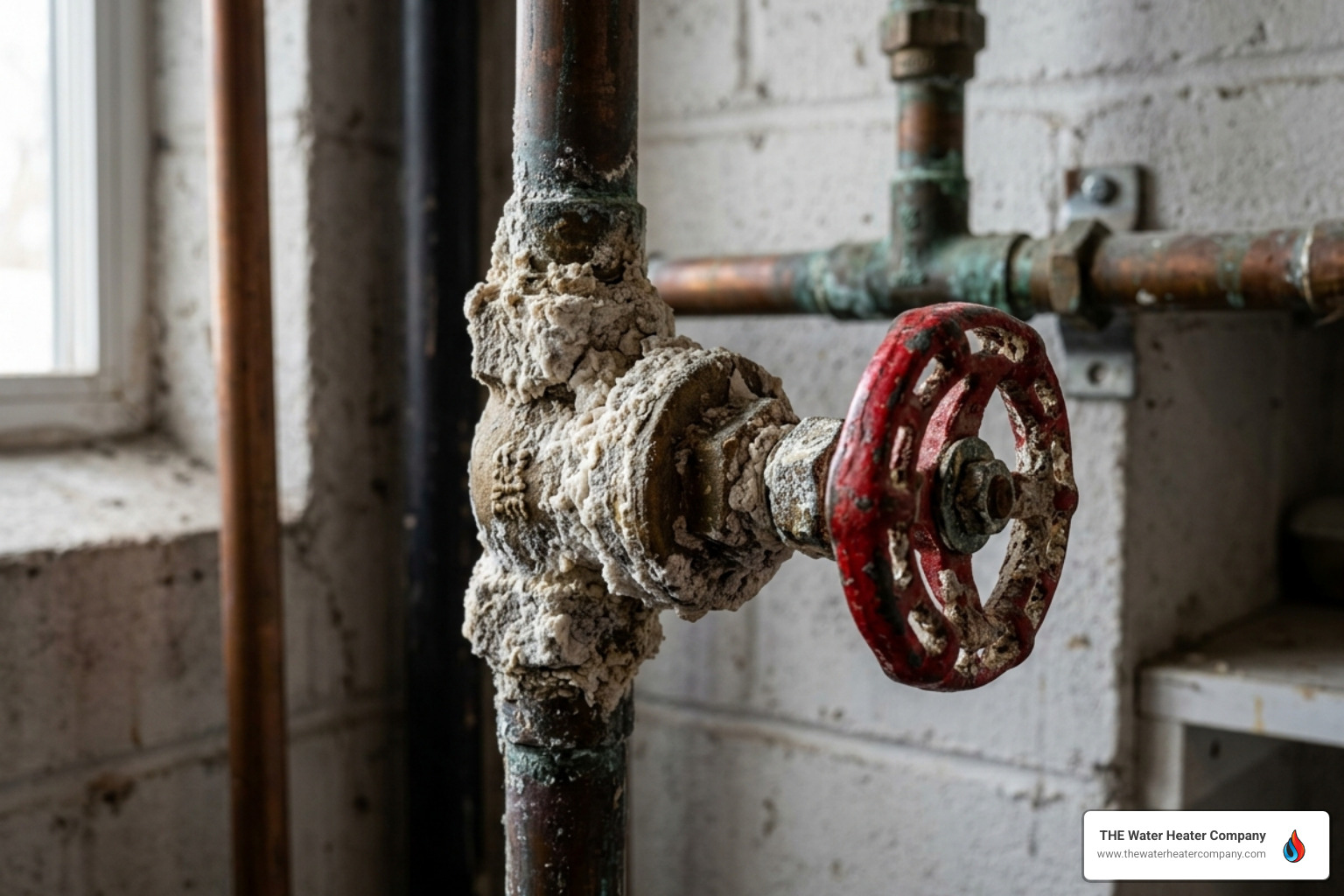
calcium buildup on a plumbing valve - signs your water heater needs repair or replacement

Living in areas like Santa Clarita, Camarillo, or Los Angeles means dealing with some of the hardest water in the country. “Hard water” is simply water with a high concentration of dissolved minerals. While safe to drink, it is devastating to plumbing appliances.

As water is heated, these minerals solidify into scale accumulation. This scale coats heating elements and settles in the bottom of tanks. In tankless water heaters, this buildup can clog the narrow heat exchanger, causing the unit to overheat and shut down. This is why annual descaling is non-negotiable for tankless owners in Southern California. Without it, a unit designed to last 20 years might fail in less than seven.

Maintenance Strategies to Prevent Premature Failure

The best way to avoid seeing the signs your water heater needs repair or replacement is to stay ahead of the curve with proactive maintenance. We recommend the following annual tasks to keep your system running at peak performance:

  1. Annual Flushing: Draining the tank to remove sediment prevents the “boiling marbles” sound and keeps the burner efficient.
  2. TPR Valve Testing: The Temperature and Pressure Relief (TPR) valve is a safety device. We test it to ensure it can still release pressure if the tank overheats.
  3. Anode Rod Inspection: Checking this rod every year can prevent the tank from rusting out prematurely.
  4. Pressure Check: High water pressure is a common cause of tank failure. We often install pressure regulators to keep your home’s PSI at a safe level (usually between 50 and 75 PSI).
  5. Expansion Tank Inspection: If you have a closed plumbing system, a thermal expansion tank protects your water heater from the pressure spikes that occur during the heating cycle.

Frequently Asked Questions about Water Heater Issues

How long do water heaters typically last in Southern California?

On average, a tank-style water heater lasts 8 to 12 years. However, due to the high mineral content in Southern California’s water, many units begin showing signs of failure right around the 10-year benchmark. If your unit was installed before 2016, it likely doesn’t meet the April 2026 efficiency standards and may be costing you more in energy than a new unit would.

Can a noisy water heater be fixed without replacing the whole unit?

In many cases, yes! If the noise is caused by recent sediment buildup, a professional flush and a “descaling” treatment can often quiet the unit down. However, if the sediment has hardened into a thick “scale” at the bottom, it may be impossible to remove, and a replacement will be necessary to restore efficiency and safety.

What are the dangers of ignoring a leaking water heater?

A small drip can quickly turn into a catastrophic flood, leading to mold growth, structural rot, and ruined flooring. Furthermore, in our earthquake-prone region, a compromised water heater is a safety hazard. We always ensure units are properly strapped and offer earthquake valves to automatically shut off gas lines in the event of a major tremor.

Conclusion

Recognizing the signs your water heater needs repair or replacement is the first step in protecting your home and your comfort. Whether you’re dealing with a “knocking” tank in Santa Barbara or lukewarm water in Pasadena, you don’t have to navigate these issues alone.

At THE Water Heater Company, we are a local, family-owned business dedicated to being the trusted authority for Southern California homeowners. Our expert technicians provide fast, reliable service with the best warranties in the industry. From Van Nuys to Santa Ana, we are here to ensure you never get left in the cold.

Don’t wait for a flood to take action. Contact us today to schedule your professional water heater diagnostic or to get a quote on a high-efficiency replacement!

Understanding the Value of Paying for a Water Heater Repair/Replacement Estimate

When faced with water heater problems, homeowners often find themselves in a dilemma. Should they pay for a service call or estimate? It’s a valid question, and one that we, at THE Water Heater Company, aim to address. In this article, we’ll explain the reasons behind charging for estimates and highlight the value-added benefits that come with it. By understanding these factors, homeowners can make an informed decision and ensure a smooth and reliable repair experience for their water heater.

Expertise and Time

Assessing and diagnosing water heater issues requires the expertise of a professional technician. These skilled individuals possess the knowledge and experience necessary to accurately identify the problem and provide the most effective solutions. They invest their time in carefully evaluating the unit, examining its components, and determining the root cause of the issue. By charging a fee for estimates, we are compensating our technicians for their valuable time and expertise, ensuring that you receive the highest quality service.

Cost Recovery

Operating a home service company involves various expenses, including maintaining a fleet of service vehicles, carrying several types of insurance, employing skilled technicians, and acquiring specialized tools and equipment, to name a few. Charging for estimates helps us recover these costs and continue providing exceptional service. By supporting us through this process, homeowners contribute to the sustainability and reliability of our business, enabling us to offer the best solutions for water heater maintenance, repairs, and replacement.

Serious Inquiries

At THE Water Heater Company, we strive to prioritize our resources and provide prompt service to homeowners who genuinely require our assistance. Charging for estimates helps us distinguish between casual inquiries and customers who are committed to resolving their water heater issues. By investing in an estimate, homeowners demonstrate their seriousness about addressing the problem, ensuring that our skilled technicians can dedicate their expertise to the customers who need it most.

Value-Added Service

Beyond simply providing an estimate, we believe in delivering comprehensive value to our customers.

When you choose to pay for an estimate, you can expect a range of additional benefits:

  • Thorough Inspection: Our technicians conduct a detailed inspection of your water heater, examining its various components to identify any potential issues or underlying causes. This comprehensive assessment ensures that no problem goes unnoticed.
  • Assessment Report: With your paid estimate, you’ll receive a detailed assessment report that outlines the identified problems, recommended solutions, and an estimated cost for repairs. This report serves as a valuable reference and helps you make an informed decision about the necessary steps to resolve the issue.
  • Professional Advice: Our experienced technicians are more than just repair experts. They can provide professional advice on water heater maintenance, and energy efficiency improvements, and answer any questions you may have. This personalized guidance ensures that you have the knowledge needed to maintain your water heater effectively and extend its lifespan.

Understanding the reasons behind charging for estimates is essential for homeowners facing water heater problems. By appreciating the expertise and time invested by professionals, recognizing the need for cost recovery, and valuing the benefits of a paid estimate, homeowners can make an informed decision. At THE Water Heater Company, we are committed to providing exceptional service and ensuring that every customer receives the highest quality repairs or replacement for their water heater. Not only that, but we apply the cost of the estimate/assessment towards the project once you are ready to move forward.

The Lifespan of a Water Heater: Knowing When to Plan for Replacement

Water heaters are essential to any home, providing hot water for showers, laundry, and more. However, like any appliance, water heaters have a limited lifespan. Knowing when to plan for replacement can save you time, money, and potential damage to your home. In this blog post, we will discuss the top five signs that your water heater is nearing the end of its lifespan and when it’s time to call THE Water Heater Company for a replacement.

Age of the Water Heater

The average lifespan of a water heater is around 8-12 years, depending on factors such as water quality, usage, and maintenance. If your water heater is approaching or has surpassed this age range, it’s time to consider a replacement. Check the manufacturer’s label on your water heater to find its age, or consult your home inspection report if you’re unsure.

Rust and Corrosion

Over time, water heaters can develop rust and corrosion. This can lead to leaks, poor water quality, and complete unit failure. If you notice rust-colored water coming from your hot water taps or visible rust on the tank itself, your water heater is likely reaching the end of its lifespan. The U.S. Department of Energy recommends flushing your water heater annually to remove sediment and prevent corrosion.

Frequent Repairs

If you find yourself frequently calling a plumber to repair your water heater, it may be more cost-effective to replace the unit entirely. As water heaters age, components can wear out and require replacement. If you’re experiencing ongoing issues with your water heater, consult a professional to determine if a replacement is the best option for your home.

Inadequate Hot Water Supply

As water heaters age, they can become less efficient at heating water. If you’re noticing that your hot water supply is running out faster than usual or the water isn’t as hot as it used to be, it could be a sign that your water heater is nearing the end of its lifespan. Upgrading to a new, energy-efficient model can save you money on energy bills and ensure a consistent hot water supply. The Federal Trade Commission offers tips on selecting energy-efficient appliances, including water heaters.

Leaks and Water Damage

Leaks can be a sign of a failing water heater and cause significant damage to your home if left unaddressed. If you notice water pooling around your water heater or signs of water damage on nearby walls or floors, it’s crucial to address the issue immediately. A professional plumber can help determine if the leak is repairable or if a replacement is necessary.

If you’re experiencing any of these signs with your water heater, it’s time to consider a replacement. THE Water Heater Company in Camarillo, CA, is here to help you choose the right water heater for your home and ensure a smooth installation process. Our experienced professionals are committed to providing top-quality service and ensuring your new water heater is installed correctly and efficiently.

Water Heater Safety Tips: Preventing Accidents and Ensuring Home Security

Water heaters are essential to modern homes, providing hot water for bathing, cooking, and cleaning. However, they can also pose safety risks if not properly maintained and used. To ensure the safety of your family and home’s safety, following some essential water heater safety tips is crucial. This blog post discusses the top 5 water heater safety tips that every homeowner should know.

Regularly Inspect and Maintain Your Water Heater

Regular inspection and maintenance are crucial for keeping your water heater in good working condition and preventing potential accidents. Some common issues to look for during inspection include:

  • Corrosion or rust on the tank or pipes
  • Leaking water around the base of the tank
  • Strange noises coming from the unit
  • Water that is too hot or not hot enough

If you notice any of these issues, it’s essential to contact a professional plumber to address the problem promptly. THE Water Heater Company in Camarillo, CA, offers expert water heater maintenance and repair services to ensure your unit remains safe and efficient.

Keep the Area Around Your Water Heater Clear

It’s essential to keep the area around your water heater free from clutter and combustible materials. This includes items such as:

  • Paper products
  • Gasoline or other flammable liquids
  • Paint or aerosol cans
  • Clothing or rags

Keeping a clear space around your water heater reduces the fire risk and allows for proper ventilation and easy access for maintenance and repairs.

Install a Carbon Monoxide Detector

Carbon monoxide (CO) is a colorless, odorless, and tasteless gas that can be deadly if inhaled. Gas water heaters can produce CO if they are not adequately vented or if the unit is malfunctioning. To protect your family from this dangerous gas, installing a carbon monoxide detector near your water heater and in other areas of your home where gas appliances are used is essential.

Set the Proper Water Temperature

Setting the correct water temperature on your water heater can help prevent scalding accidents and save energy. The U.S. Department of Energy recommends setting your water heater’s temperature to 120°F (49°C) for optimal safety and efficiency. If you have young children or elderly family members in your home, you may want to consider installing anti-scald devices on faucets and showerheads to reduce the risk of burns further.

Know How to Shut Off Your Water Heater and Gas Supply

Knowing how to shut off your water heater and gas supply quickly is essential in an emergency. Familiarize yourself with the shut-off valves’ location for the water and gas lines connected to your water heater. In the event of a leak, fire, or other emergency, shutting off the supply lines can help prevent further damage and ensure the safety of your home and family.

By following these water heater safety tips, you can help prevent accidents and ensure the security of your home. If you need assistance with water heater maintenance, repair, or installation, the experts at THE Water Heater Company in Camarillo, CA, are here to help.

How to Care for and Troubleshoot Your Noritz Tankless Water Heater

Noritz tankless water heaters present you with error codes when something is wrong, and knowing how to understand these error codes and troubleshoot them appropriately is truly vital. That’s what we’re going to cover for you today. We know how frustrating it can be when you’re faced with what seems like a random code that you’ve never seen before. But we’re about to clear things up for you.

We’ll first discuss how to take care of your Noritz tankless water heater and then move onto the common problems and the error codes attached to them. That way, you’ll know what the problem is and what to do about it next time your water heater displays an error code. Read on now to find out more.

How to Care for Your Noritz Tankless Water Heater

One thing you can and should do regularly to maintain your Noritz tankless water heater in the right way is to purge the port valves. You do this by attaching hose lines and opening the relevant purge port valves. As long as you prepare properly and have a safe discharge location, this should be an easy process and it’ll remove waste from the heater system.

You can also use undiluted white vinegar to clean out the water heater now that you’ve purged its lines. There’s a range of draining and flushing procedures recommended by the manufacturer so be sure to follow these when cleaning out the water heater. Whatever you do, don’t use harsh chemicals during the cleaning process because these will only cause damage.

When all that’s done, you’ll want to turn the water on again. This is something that you should do slowly in order to remove any trapped air from the system. Do it by finding the faucet furthest away from the heater and turning it on slowly because this will remove the air safely.

Noritz Tankless Water Heater Troubleshooting Guide

When you see an error code, it means there’s something wrong with your Noritz tankless water heater. Most of these problems can be fixed pretty easily with a basic set of tools, even if you’re no expert. Find out about some of the most common error codes and how to troubleshoot them below.

Error Code 05

This is an automatic service reminder telling you that your system is due to a service. When you see this, call a licensed technician and book a service.

Error Code 10

If the combustion continues or the power drops even after the unit has been turned off, you’ll see this error code. Look for foreign objects and materials like oil and grease on the burner that might still be burning.

Error Code 11

Error Code 11 signals a problem with the ignition. When there’s an ignition failure in your water heater, you should check the gas pressure and see if there’s anything obstructing the air supply. Any such obstructions should be removed.

Error Code 12

When the water isn’t being heated properly, it’s often because of a weak flame. Check the airflow is correct and make sure the flame sensor isn’t being covered by any debris. Cleaning it might fix the problem too.

Error Code 14

This error code means the thermal flame has failed for some reason. It might be necessary for you to replace the thermal flame. Flushing the heat exchanger and checking the water quality is important because this can cause it to clog up.

Error Code 16

This error code is telling you that the water temperature is too high. This is usually caused by scale buildup or hard water, so descaling the system is a good idea. The maintenance process described above can be used.

Error Code 20

This error code shows when the high limit switch has been activated. Checking the switch and replacing it if necessary is one thing you can do. If that’s not necessary, descaling the water heater might be the answer.

Error Code 29

When the water level in the neutralizer isn’t draining correctly, you’ll see Error Code 29. To overcome the problem, you’ll need to ensure the condensate drain line is correctly routed and no obstructions are causing problems.

Error Code 59

This error code means that there’s low gas BTU input and that combustion problem are being caused as a result. Ensure air is flowing to the combustion chamber and set the correct gas pressure to address the problem. Cleaning the fan and burner chamber might help too.

Be sure to follow the advice outlined above next time you have a problem with your Noritz tankless water heater. Just find the error code that’s being displayed and take the actions we’ve described here.

The Most Common Problems with Tank Water Heaters

When your hot water heater is not heating, it is important to remember that every hot water appliance is going to be prone to the occasional problem. It may be due to regular wear and tear, lack of maintenance, or a malfunction, amongst other things. Here, we’re going to take a closer look at some of the common problems affecting tank water heaters, how you may be able to prevent them, and what can be done about them when they do occur.

Gas & Electric Water Heater Repair & Maintenance

Since there are two kinds of tank heaters, gas and electric, there are also problems that can be specific to each type, so there are reasons that your gas water heater is not working that would not apply to electric water heaters. Bear in mind which type of water heater you have before applying a solution. If your electric or gas hot water heater is not heating, this is the article for you. If your tankless hot water heater is not heating, head over to our tankless water heater blog for help.

***Safety First***

Before doing any troubleshooting or making any attempts to fix an issue with your tank water heater, ensure that you’ve taken safety precautions. Electric water heaters are high-voltage appliances that can be risky to work on. Similarly, gas water heaters come with the risk of fire, explosions and carbon monoxide leaks when not handled by a professional.

Make sure the electricity and gas supply is off before doing any troubleshooting and know when to call a professional. For electric devices, make sure you use a non-contact voltage tester to ensure the power is off before touching any wiring.

Problem #1: No Hot Water

The most glaring issue with a water heater is when there’s no hot water at all. If your hot water heater is not heating, a lack of energy supply is a common culprit, so make sure your electricity is on or that you have a functioning gas supply. If your energy supply is fine, the issue may be with the heating element or ignition. Check to see if the breaker has tripped and switched it off and on if it’s electric.

You can also reset the high-temperature limit on electric systems by turning off the breaker and pressing the red high-temperature cut-off reset button above the thermostat, beneath the insulation and plastic guard. Otherwise, you may need a professional to look at the heating element, ignition, or flame.

Problem #2: Low Hot Water

One of the benefits of tank water heaters is that with enough time to heat up, they should be able to supply plenty of hot water to meet the needs of simultaneous and frequent hot water use. However, if you’re feeling like it’s not producing enough hot water, the heater may have too low of a capacity. If this is the case, then there’s little to do but reduce your hot water use or to install a bigger heater that’s suited to the household’s demands.

If you don’t think that the heater is undersized, then it might be another heating element or ignition issue. Follow the tips as mentioned in the “no hot water” section above and get in touch with a professional to help diagnose the issue.

Problem #3: The Water is Too Hot

Usually, this is due to an issue with the thermostat. It may simply be set too high. If this is the case, you should locate and adjust it. Check your heater’s manual to find where the thermostat is. For gas-powered heaters, it’s usually externally visible, but for electric models, there’s another one beneath the access panel.

If turning the thermostat doesn’t work, get in touch with your local plumbing and HVAC specialist. Water that’s too hot can lead to a range of issues, including burns and faulty faucets due to worn rubber washers.

Problem #4: Sediment, Mineral & Bacteria Buildup

If your water has a rusty color, is cloudy, or has a strange odor to it, then it may be due to a build-up of either minerals or sediment in the pipes. If there’s an odor that smells like rotten eggs, however, there may be bacteria in the tank that is reducing your water’s quality. Replacing the anode rod in the tank can help with that.

Iron pipes and plumbing can lead to rust, and iron sediment can get trapped, diminishing the flow of hot water and reducing its temperature and pressure. In homes with hard water, calcium and magnesium can do the same.

Regular flushing of your systems can prevent buildup. Your systems should be flushed annually. There are at-home kits you can use to do this, but it is recommended that you consult a professional who has more appropriate, heavy-duty equipment for the job.

Need Help with Tank Water Heater Troubleshooting?

If your electric or gas water heater is not working, and you’re not comfortable applying any of the fixes above, get a professional on your side. At THE Water Heater Company, we are dedicated to diagnosing any issues your tank water heater may have and resolving them as quickly and efficiently as possible. We can offer you expert tank water heater service and repair to ensure your water heater stays up and running the way it should.

Contact the professionals at THE Water Heater Company today to schedule a gas or electric water heater repair service visit.

Most Common Problems With Tankless Water Heaters

What Are the Most Common Problems With Tankless Water Heaters?

As advanced and convenient as they are, all tankless water heaters are susceptible to problems as they experience wear and tear. No appliance is without the risk of fault throughout its lifetime. Unlike traditional tank water heaters, tankless water heaters come with their own set of common problems.

Tankless water heaters offer excellent energy efficiency, space-saving in the property, and the potential to save money. Those benefits can be undermined by certain issues, however, so it’s important to understand what common problems are and how to avoid or resolve them.

Overload

Every tankless water heater has a flow rate capacity that should give you a good idea of how much hot water can be used simultaneously. If you go over that capacity, then you could overload the system and cause problems. This is a common issue because many homeowners don’t realize that tankless water heaters have limitations for simultaneous hot water usage.

If your tankless water heater is overloaded, then you might find that some of the users are getting hot water and others aren’t. In some cases, a system overload can lead to the heater shutting down entirely.

The best way to prevent a system overload is to understand your heater’s capacity and how many different appliances can use it at the same time. If you’re running into a consistent issue, however, call a professional. You may need to consider upgrading your heater or even getting a second heater to make up the deficit.

Cold Water Sandwich Effect

You may not be familiar with the term “cold water sandwich”, but if you live in a home where back-to-back showers are frequent, you will likely be familiar with the sensation.

A cold water sandwich is when one person finishes showering and another person gets in right after. The water starts off hot but soon turns cold for a few seconds up to a minute before starting to heat up again.

This happens because when the shower is turned off, the water is no longer heated, but there’s still some hot water in the pipes. This hot water comes out first before the cold water follows. The tankless water heater will be working to get the water heated back to a normal temperature, so it shouldn’t be cold for too long.

This effect isn’t so much an issue with your heater as it is part of its design. While tankless heaters are known for quick heat times, the fact that hot water cannot be stored makes it impossible for the system to ensure hot water immediately after it has been turned off and turned on again.

However, if you notice that these cold spells during your shower are longer than a minute or so, you may be experiencing other issues, and it would be wisest to consult a professional.

Mineral or Sediment Buildup

The water heater and the pipes could be susceptible to becoming blocked partially or fully due to a buildup of minerals or sediment. Systems with iron pipes and components can rust and lead to iron sediment building up throughout. Meanwhile, homes with hard water could see minerals like calcium and magnesium resulting in a scale buildup.

Over time, these minerals and sediment can become stuck in place, leading to a gradually growing buildup that narrows the passage that the water moves through. This can affect the pressure and temperature of the water and make it potentially unsafe.

If you are experiencing problems relative to buildup, you’ll need to call a professional to flush your system. This should be a part of your regular annual maintenance so as to avoid more damaging issues caused by mineral or sediment buildup.

Flame or Ignition Failure

“My tankless water heater doesn’t get hot enough”. This may be a question you are asking, it could be that the flame fails to hold or ignite, then it is likely due to an electrical issue or a gas line issue. Either way, your heater will be unable to heat the water. First, check to see if your propane tank is low or if your gas supply has been cut due to a late bill.

If your gas supply is fine, see that your water and gas valves are fully open, and open them if they aren’t. If this doesn’t help, then you should get in touch with a professional who is qualified to work safely with gas appliances, as the issue could be anything from regulator failure to an undersized gas line and could pose dangers to your home.

Call THE Water Heater Company Today

Dealing with hot water appliances can be dangerous, so if you’re uncomfortable with any step of troubleshooting or maintaining your tankless water heater, contact a professional right away. Our experts at THE Water Heater Company can safely handle any issues you’re experiencing and offer you the right tankless water heater services for your needs.